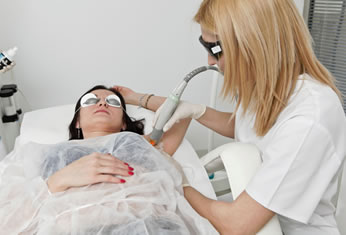
How long does a laser hair removal session take? Which areas can be treated? Useful advice on laser hair removal.
Permanent LASER hair removal is a medical-aesthetic procedure that uses a beam of laser light to remove unwanted hair. The light targets the pigmented bulb of the hair specifically, and the heat generated destroys the hair follicle and inhibits future hair growth. The procedure does not harm the surrounding tissue. Below are the answers to the most frequently asked questions about LASER HAIR REMOVAL.
What is melanin, and how does it influence the choice of hair removal method?
Melanin is the pigment that gives our skin its colour. It absorbs the sun's rays and protects the skin from burning. The melanin present in the hair makes an excellent target for laser energy, which is why this method of hair removal works so well.
What is photoepilation?
Photoepilation destroys hair follicles using flashes of light at a particular wavelength and intensity, controlled by a laser machine. The light energy is very powerful. The bulb of the hair absorbs the light delivered by the machine, and the resulting heat destroys it. For the best results, the energy emitted by the laser machine has to be absorbed by the hair and not by the neighbouring tissues.
Does laser hair removal work for me?
Because the laser targets melanin, the more melanin there is in the hair bulb (that is, the darker the hair), the faster and more effective laser hair removal will be. This is why people with white, blond, red or greying hair do not get good results from this method.
Where can I have laser hair removal?
You can have laser hair removal at medical dermatology clinics, at beauty salons or at home. In recent years devices for home use have appeared on the market. There are as yet no studies comparing how well hair removal works with these devices against hair removal in a medical clinic. If you choose this kind of device, read and follow the instructions carefully in order to reduce the risks, particularly to the eyes.
Do I need a dermatological consultation before having laser hair removal?
A dermatologist experienced in laser technology is the only person able to decide whether you are a candidate for laser hair removal. At the first consultation the doctor may ask about your medical history, will establish your skin type (phototype) and will explain the risks and the benefits of laser hair removal. To reduce the risk of complications, the doctor will ask questions about any long-term medication (for example aspirin, non-steroidal anti-inflammatories, contraceptives, cardiac treatment) and about nutritional supplements such as niacin or vitamin A. If you are tanned (from the sun, a sunbed or self-tanning products) you have to wait until the tan has completely gone before laser treatment. Avoid any hair removal method that pulls the hair out (waxing, tweezing or an electric epilator) for at least 3 weeks before the visit to the doctor. The only method allowed is shaving.
What do people risk if they choose a full course of laser hair removal but the equipment at that clinic or salon is not up to standard?
Poor equipment can make the method ineffective, or cause local reactions such as burns or loss of pigment. Untrained staff do not give the necessary information, do not recognise the situations in which there are contraindications, and do not use the machine at its optimal settings.
What are the advantages of laser hair removal?
It is worth noting that laser hair removal is a non-invasive method involving no needles and no chemicals. The technique is completely safe for the patient if it is carried out correctly and with good equipment, and it is less painful than other methods. Many patients enjoy the experience of hair removal that lasts for years, or even permanently. The method works very well for removing hair from large areas such as the back, the chest and the legs. The skin is smooth and silky all the time, and there is no longer any need for an appointment at the beauty salon every three weeks. It is the only effective form of hair removal in pseudofolliculitis, pili torti (hairs that grow under the skin), idiopathic hirsutism and the hirsutism of polycystic ovary syndrome.
Read more about the laser used with success at the Dermestetica clinic.
What are the limits and disadvantages of laser hair removal?
Although laser hair removal is an excellent option for treating excessive hair, some patients may see a few hairs reappear. This is why a few maintenance sessions are needed, once every 2 years. The new hairs are fine and lighter in colour. Other possible side effects sometimes appear as well: passing erythema (redness) and/or oedema (swelling) in the treated area.
If the skin has been exposed to the sun or a sunbed before the laser session, the treatment may result in burns, scars or changes in colour. This is why a careful history and an informed clinical examination are needed before treatment. The process is ineffective for those with unpigmented, blond or red hair.
Which areas can be treated with the laser?
Any area apart from the region around the eyes can be treated with the laser. The most requested areas are the face, the upper lip, the neck, the chin, the underarms, the groin, the area around the areolae and the legs.
How long does a session take?
Laser hair removal is a very quick method, considering its long-term results. For example, a session for the whole leg takes about an hour. For the same area, electrolysis takes 125 hours.
What are the medical instructions before treatment?
- Laser treatment should be avoided when you are tanned or sunburnt.
- How long you have to avoid the sun or a sunbed varies with the kind of laser equipment used. Discuss this with the dermatologist carrying out the laser treatment. The Nd:YAG laser is the only one that can carry out hair removal on dark skin as well.
- The hair should be freshly shaved before the laser session and between sessions too. NOTE: no other hair removal method is allowed during the treatment apart from shaving.
- Bleaching the hair should stop at least 2 weeks before the laser session.
- If you suffer from oral or genital herpes, talk to your dermatologist.
What are the instructions after treatment?
- It is usual for the skin to be slightly erythematous (red) immediately after the treatment, with small swellings (follicular oedema) at the follicles. These usually settle at once with ice or soothing lotions.
- Remember: apply the smallest amount of make-up and the largest amount of the moisturisers your doctor recommends. Use a sunscreen with factor 30 (for darker skin) or 50+ (for fair skin). The hair will carry on growing normally for 2 weeks after the session, and only then will the hairs whose bulbs were destroyed fall out. So islands of hair will remain on the skin.
How does skin colour affect the results of laser hair removal?
Fair skin and dark hair are the ideal combination for laser hair removal. Few sessions are needed (4 to 6) and excellent results are obtained. For people with darker skin, more sessions are needed (6 to 8) for the same results, because very high energies cannot be used. The laser treatment plan (the number of sessions and how often they are held) is drawn up individually for each patient.
Does diet have any impact on the treatment?
In general diet has no influence on the treatment, with the exception of beta-carotene, which interferes with laser treatment. Beta-carotene, usually found in carrots, tomatoes, beetroot and vitamin A supplements, is stored in the skin and gives it a slightly orange colour. This pigment absorbs the laser energy in the skin and deflects it away from the hair bulb. Beta-carotene persists for months after being eaten in quantity. It is therefore advisable not to overdo foods containing it in the diet.
What are the contraindications for permanent laser hair removal?
- People who are pregnant or breastfeeding, and those with dysplastic naevus syndrome, are advised against this procedure.
- Because of the risk of eye damage, the method is also not used in the area around the eyes.
- Caution is needed for patients with recurrent herpes and for those taking photosensitising medicines.
- It is not applied over moles. These are protected during the laser sessions.
Does LASER therapy cause skin cancer? MYTH or TRUTH?
The light energy generated by the laser does not go beyond the level of the hair follicle. It therefore acts superficially. There are also studies according to which the action of the laser does not damage DNA and does not produce cellular mutations that could cause skin cancer in normal skin. Even so, it is advisable for melanocytic naevi (moles) to be avoided or covered during the treatment.
Is laser hair removal more effective than IPL?
This is a debate that is still current. Both treatments produce energy in order to interrupt the growth cycle of the hair follicle and stop it growing, without harming the surrounding tissue. The similarity between the two kinds of equipment ends there.
The great difference between them lies in the technology used to produce the light.
Read at length about the difference between the two procedures.
ND:YAG LASER HAIR REMOVAL PRICES