Everything you need to know about botox: kinds of botulinum toxin, how it works, the areas treated, the medical indications, results day by day and aftercare.
Botox is the most frequently performed non-surgical aesthetic treatment in the world, and also a procedure weighed down with myths. In this guide the Dermestetica dermatologists explain what botulinum toxin is, what kinds there are, how it works, which areas are treated, when it is used medically, and what results are realistic, day by day.
Botox in short
- What it is: a purified protein that temporarily relaxes the muscle it is injected into, by blocking the nerve signal.
- Botox injection treats: facial expression lines (forehead, glabella, crow's feet), a gummy smile, the jawline, and also hyperhidrosis, chronic migraine and bruxism.
- When it shows: the first changes appear after 3-5 days, the full effect at about 14 days.
- How long it lasts: on average 4-6 months on the face and 6-9 months in underarm hyperhidrosis.
- How long the session takes: 10-20 minutes, and ordinary activities resume immediately.
- The price depends on the number of areas treated, the dose needed and the product used. At Dermestetica, treating the glabellar area costs 950 lei, and the package for 3 areas (glabella, forehead and crow's feet) costs 1,860 lei.
What botulinum toxin is
Botulinum toxin is a neurotoxin produced by the bacterium Clostridium botulinum. In its natural form it is one of the most powerful biological substances known, but medicine uses a purified form, made under pharmaceutical conditions and given in extremely small doses, expressed in biological units. What separates a dangerous substance from a safe medicine is the dose, the purity and the exact place of injection.
Botox is in fact the trade name of a single product (onabotulinumtoxinA), which in everyday speech has become a synonym for every botulinum toxin. According to StatPearls, the medical resource of the US National Library of Medicine, the toxin has been in clinical use since the late 1970s. The first therapeutic approval came in 1989, for strabismus and blepharospasm, and the first aesthetic approval in 2002, for the lines between the eyebrows. Today botulinum toxin has indications in neurology, urology, ophthalmology, gastroenterology and dermatology.
Kinds of botulinum toxin
The bacterium Clostridium botulinum produces seven main serotypes of the toxin, labelled A to G. Only two of them are used in medicine:
- type A, which covers almost every aesthetic treatment and most of the medical ones
- type B, used mainly in neurology
Both types relax the muscle by blocking the release of acetylcholine, but they act on different proteins in the nerve ending.
What botox does and how it works
For a muscle to contract, the nerve releases a chemical messenger called acetylcholine. Botulinum toxin enters the nerve ending and temporarily blocks the mechanism by which acetylcholine is released. The muscle receives a weaker signal, relaxes, and the skin above it no longer folds as strongly.
The effect is reversible. Over the following months the nerve ending rebuilds the proteins that were blocked and forms small new branches, so movement returns gradually, on average after 4-5 months. The same mechanism explains its use in the treatment of hyperhidrosis with botulinum toxin: the sweat glands are also commanded through acetylcholine, so the toxin reduces the production of sweat in the area treated.
Botox acts on dynamic wrinkles, the ones that appear with movement. Static wrinkles, visible even with the face at rest, improve partly with botox and answer best to combinations with hyaluronic acid injections, the Ultra Pulse CO2 laser or biostimulation treatments such as Profhilo.
Aesthetic indications for botulinum toxin
In aesthetics the aim of the treatment is a rested, expressive face with finer expression lines. A natural result depends on three things: reading the movement of the face correctly, a dose matched to each muscle, and precise placement of the injection points.
Expression lines by area (forehead, glabellar lines, crow's feet, bunny lines, perioral)
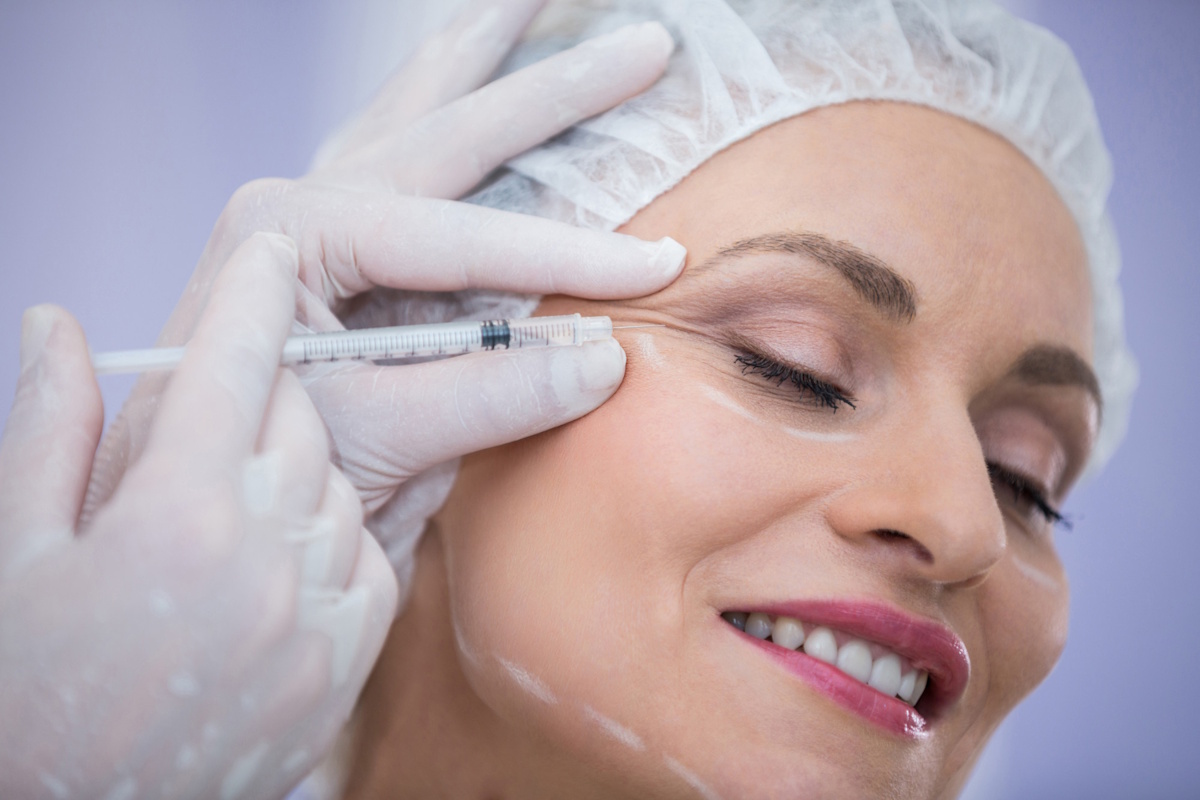
Botox injection smooths the lines at the sides of the eyes, which appear when you smile
Forehead lines. The frontalis is the only muscle that lifts the eyebrows. For that reason the doctor treats the forehead with carefully calculated doses and usually together with the glabella (the area between the eyebrows), to keep the balance of the gaze and the natural position of the eyebrows.
Glabellar lines (the two vertical lines between the eyebrows, the "11 lines"). They are made by the corrugator and procerus muscles and are the most studied aesthetic indication. Treating them often also gives the sense of a more relaxed, less frowning gaze.
Crow's feet (the lines at the sides of the eyes). They appear through the contraction of the lateral part of the orbicularis oculi muscle, particularly when smiling. Superficial injections smooth them and keep the smile natural.
Bunny lines (the lines on the nose). These are the oblique lines that appear on the side of the nose when frowning or smiling broadly. They sometimes become more visible after the glabella is treated, by compensation, and are corrected with a few units per side.
Perioral lines (above the lip). These are treated with microdoses, to keep the mouth working as it should. Botox does not add volume to the lips. For volume and contour the right answer is hyaluronic acid, and combining the two treatments gives the best results in this area.
Baby botox and brotox (preventive, men)
Baby botox means microdoses spread over more points, for a subtle effect: the movement of the face stays almost unchanged while the fine lines soften. Patients often choose it between 25 and 35, when the lines appear only on movement and can be stopped from becoming static. The effect lasts rather less than with standard doses, usually 2-3 months.
Brotox is the informal name for botox treatment in men. Men generally have stronger facial muscles, so they often need higher doses. The aesthetic objective matters just as much: the doctor keeps the eyebrows straight and masculine, and avoids arching them.
Gummy smile, chin and jowl contouring, the Nefertiti lift
The gummy smile. When more than 3-4 mm of gum shows on smiling, the cause is often an overactive upper lip muscle. 1-2 units injected on each side lower the lip slightly and balance the smile, in a procedure of a few minutes.
The chin. The mentalis muscle, when overactive, gives the chin an orange-peel look. Relaxing it smooths the area, and treating the muscle that pulls the corners of the mouth down (the DAO, depressor anguli oris) lifts the expression slightly.
Jowls and the line of the neck. One important point: botox does not dissolve the fat under the chin. It acts on the muscle responsible for the vertical bands of the neck and for pulling the jawline down. For fat under the chin the right options are others, non-surgical HIFU lifting for instance.
The Nefertiti lift consists of injections along the edge of the jaw. The result is a more defined jawline and a smoother neck. The ideal candidates have good skin elasticity; where laxity is advanced, the result is more discreet.
Medical (non-aesthetic) indications for botox
Botulinum toxin is, first of all, a medicine. A great many of its uses have nothing to do with wrinkles, and in dermatology the list of indications grows from year to year.
- Hyperhidrosis (excessive sweating) of the underarms, the palms or the soles. According to the American Academy of Dermatology (AAD), a single treatment can reduce sweating for up to 6 months. Read more about how excessive sweating becomes a medical problem.
- Bruxism and pain in the temporomandibular joint. Relaxing the muscles reduces the force of clenching, the pain and the wear on the teeth.
- Neurological conditions: blepharospasm, hemifacial spasm, cervical dystonia (spasmodic torticollis), spasticity after a stroke.
- Other medical indications: overactive bladder, excessive salivation, strabismus.
- Dermatological uses that are expanding fast: the persistent redness and flushing episodes of rosacea, and improving the look of recent scars by reducing the tension around the wound. A review published in Molecules in 2022 goes through these uses and the level of evidence for each.
Who is a suitable candidate
The ideal candidate for an aesthetic botulinum toxin treatment is a healthy adult with expression lines visible on movement, who wants a natural look and has realistic expectations. The treatment suits women and men alike, and can be begun preventively or correctively.
The doctor postpones it, or recommends other options, in the following situations:
- pregnancy and breastfeeding;
- neuromuscular disease, such as myasthenia gravis, Lambert-Eaton syndrome or amyotrophic lateral sclerosis;
- active infection in the area to be injected, including a cold sore in flare;
- a known allergy to any of the product's components;
- ongoing treatment with certain antibiotics of the aminoglycoside class, which can potentiate the effect of the toxin;
- an important event in less than two weeks, when the effect has not yet had time to settle.
If you take anticoagulants or antiplatelet medication, tell the doctor at the consultation. The risk of bruising is higher, and any decision about your medication is one you take only together with your doctor.
How the injection procedure goes
A botulinum toxin treatment is a medical act and always begins with a dermatology consultation. At Dermestetica the procedure follows a few clear steps:
- The assessment. The doctor goes through your medical history, previous treatments and what concretely bothers you. You are then asked to frown, raise your eyebrows and smile, so the strength and the path of each muscle can be seen.
- The treatment plan. The doctor settles the areas, the injection points and the dose. Every face moves in its own way, so the map of points is personal.
- Preparing the skin. The area is cleaned and disinfected. For sensitive patients, ice is applied a few minutes beforehand.
- The injection. A very fine needle is used, and each point takes a few seconds. The whole procedure takes 10-20 minutes.
- The check at two weeks. The doctor looks at the symmetry and, if needed, makes a small adjustment.
The effects and results of botox
Results come on gradually. According to the AAD, most patients see the effect within 3-7 days, and the improvement holds on average for 3-4 months, sometimes longer.
| When | What happens |
|---|---|
| Day 0 | Small bumps at the injection points, which disappear within 15-30 minutes. You can resume your usual activities immediately. |
| Days 1-2 | As a rule nothing is visible yet. With the newer liquid toxins, some patients feel the first changes earlier. |
| Days 3-5 | The muscles begin to relax and the lines soften. |
| Days 7-10 | The effect is obvious to most patients. |
| Day 14 | Full effect. This is the right moment for the check and any adjustment. |
| Months 4-5 | Movement returns gradually. You can book the next session. |
Common, passing side effects: redness at the injection points, small bruises, local tenderness or a mild headache on the first day.
Rare side effects: a slight drooping of the eyelid or the eyebrow, asymmetry, or an exaggerated arch of the eyebrow. These are temporary, go as the effect wears off, and many are corrected at the two-week check itself.
When to see a doctor urgently: if you have difficulty swallowing, speaking or breathing, double vision or generalised muscle weakness. At aesthetic doses these situations are exceptional, but they must be recognised.
Resistance to treatment. A small number of patients develop antibodies that reduce the effect of the toxin. The risk falls when correct doses are used, sessions are kept at least 3 months apart, and repeated adjustments at short intervals are avoided.
A less well known benefit: with repeated treatments the muscle can weaken slightly, and the results can last longer over time. The effect is, however, reversible once treatment stops.
What a botox injection costs
At Dermestetica we carry out botulinum toxin injections for the area between the eyebrows (the glabellar area), for the forehead or around the eyes. We set the price according to the area and how many areas there are.
Here are some examples of prices for botox injection:
| Kind of botox injection | Price |
|---|---|
| Botulinum toxin, glabella | 950 lei |
| Botulinum toxin, 3 areas | 1860 lei |
Aftercare following botox treatment
Aftercare following botox is simple, and its purpose is to keep the toxin in the muscle it was injected into. The recommendations below are the ones dermatologists ordinarily use:
- Stay upright for 4 hours after the treatment.
- Do not massage, rub or press the treated areas for the first 24 hours. Apply make-up with a light touch.
- Leave intense exercise until the next day.
- Avoid the sauna, hot baths, sunbeds and prolonged heat for 24-48 hours.
- Limit alcohol on the first day, to reduce the risk of bruising.
- Book intense facial treatments (facial massage, radiofrequency, HIFU, peels) for at least 1-2 weeks after botox.
- Keep to your usual skin care routine and use sun protection daily.
The Dermestetica doctor's advice
"Botulinum toxin injection is an excellent treatment, entirely reproducible, which gives us a relaxed, rested, optimistic look in just a few minutes. The secret of a natural result lies in not blocking the frontalis and the periocular muscle (orbicularis oculi) entirely, because it is with those muscles that we express most of our emotions." - Dr. Daniela Popoiu, specialist in dermatovenereology, Dermestetica
Myths about botox
Myth: "Botox is poison"
The truth: the doses used are hundreds of times smaller than those that would put health at risk. The purified toxin has been used in medicine for more than 40 years, including in children, for neurological conditions.
Myth: "Botox freezes your face"
The truth: the "frozen" look comes from doses that are too high or points chosen wrongly. A correct treatment reduces the intensity of movement and keeps expressiveness. The AAD states that dermatologists inject exactly as much as is needed to relax the target muscles, and that the sensitivity of the skin is unchanged.
Myth: "Botox fills wrinkles"
The truth: botox relaxes the muscle, it does not add volume. Filling and contouring are done with hyaluronic acid.
Myth: "If you stop botox, the wrinkles get worse"
The truth: as the effect wears off, the face returns to its natural look. The period of muscle relaxation has in fact slowed the deepening of the lines.
Myth: "Botox is addictive"
The truth: the body develops no physical dependence. Many patients choose to continue because they like the result, which is a preference, not an addiction.
Myth: "Botox builds up in the body"
The truth: the toxin acts locally and is broken down naturally by the body.
Myth: "The effect is immediate"
The truth: the effect sets in over a few days and is at its fullest at about two weeks.
Myth: "Botox is only for women"
The truth: the number of men choosing the treatment grows steadily, and the technique is adapted to male anatomy.
Myth: "Only the price matters, the product is the same everywhere"
The truth: the result depends on the product being genuine, on it being stored correctly and on the doctor's experience. The AAD has drawn attention to the risks of counterfeit products and recommends that injection be carried out in a medical practice, by a trained doctor.
FAQ - frequently asked questions about botox
How long does a botox session take?
The injection itself takes 10-20 minutes. With the consultation, the photographs and preparing the skin, the visit to the clinic takes around 20-30 minutes.
Does botulinum toxin treatment hurt?
Most patients describe the sensation as short, one-second pricks. The needle is very fine, and the ice applied beforehand reduces the discomfort further. The areas around the lips and the underarms are rather more sensitive.
After how many days do the results show?
The first changes appear after 3-5 days, the result is obvious at 7-10 days, and the full effect sets in at about 14 days.
Can you have botox in summer?
Yes, you can have botox treatment in any season. The toxin does not react to the sun, as some peels and laser treatments do. The recommendation is to avoid intense heat, the sauna and the beach for the first 24-48 hours, and to book the treatment at least two weeks before your holiday, so you can enjoy the full effect while you are away.
What happens if I stop the treatment?
The effect fades gradually, over a few months, and the muscles regain their usual strength. The face returns to its natural look, with no rebound effect. In patients treated regularly for years, the muscles may stay a little more relaxed, and the lines can be finer than before the first treatment.