
Sun allergy: solar urticaria or polymorphic light eruption? How to tell them apart, what treatment exists and how to prevent the eruption.
Sun allergy is a general term for the appearance of a skin eruption after exposure to ultraviolet radiation. The eruption takes the form of erythematous plaques and papules (red, slightly raised patches and bumps) or of blisters.
Two distinct conditions come under this name: solar urticaria and polymorphic light eruption. They have to be distinguished from other eruptions set off by the sun, which is why the correct diagnosis belongs to the dermatologist.
What sun allergy is
Sun allergy is not a single disease but a common name for several skin reactions set off by exposure to ultraviolet light. The eruption shows as erythematous plaques and papules (red, slightly raised) or as blisters, accompanied by itching.
In dermatological practice, two conditions are included under the term sun allergy:
- solar urticaria – rare, with lesions that appear quickly and disappear quickly;
- polymorphic light eruption – far more common, with varied lesions that persist longer.
These two conditions have to be distinguished from other eruptions that follow exposure to ultraviolet light as part of other skin diseases:
- the light eruption of lupus, which comes with other manifestations as well;
- the photosensitivity of the cutaneous porphyrias;
- phototoxic reactions, which appear after contact with various substances followed by exposure to ultraviolet light;
- miliaria rubra (heat rash);
- heat urticaria.
This is also why self-diagnosis does not work here: eruptions that look similar can have completely different causes and completely different treatments.
Sun allergy versus heat rash
The two are frequently confused, but they have different triggers.
Sun allergy is set off by ultraviolet radiation. It appears on the areas exposed to the sun and can appear even through thin clothing, because ultraviolet light can pass through it.
Heat rash (miliaria rubra) is set off by heat and sweating, not by ultraviolet light. It typically appears where sweat remains trapped: in the folds of the skin, under tight clothing, on the back and on the neck. It has nothing to do with direct sun exposure.
A practical clue: if the eruption appears on covered, sweaty areas, it is more likely to be heat rash. If it appears on sun-exposed areas shortly after exposure, it is more likely to be a reaction to ultraviolet light. The distinction is made by the dermatologist, though, because heat urticaria also exists and complicates the picture.
Kinds of sun allergy and what they look like (images)
Solar urticaria
Solar urticaria is a rare condition. It appears in all races, usually beginning between the ages of 20 and 40.
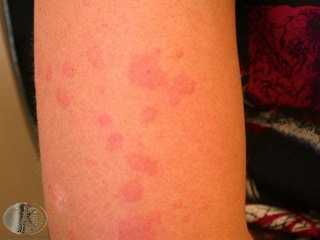
Solar urticaria can disappear very quickly once sun exposure stops. Source: DermNet
It shows as round, erythematous, itchy lesions after a short period of exposure to ultraviolet light, usually under 30 minutes. The lesions can appear on sun-exposed areas even where these were covered by thin clothing. They may, on the other hand, be absent from the face and the hands, since these are chronically exposed to the sun and may be desensitised.
The key element for diagnosis is how quickly the lesions disappear. Once sun exposure stops, they begin to fade within minutes to hours and have resolved completely within 24 hours.
It is a chronic condition, although spontaneous remissions have been reported.
Polymorphic light eruption
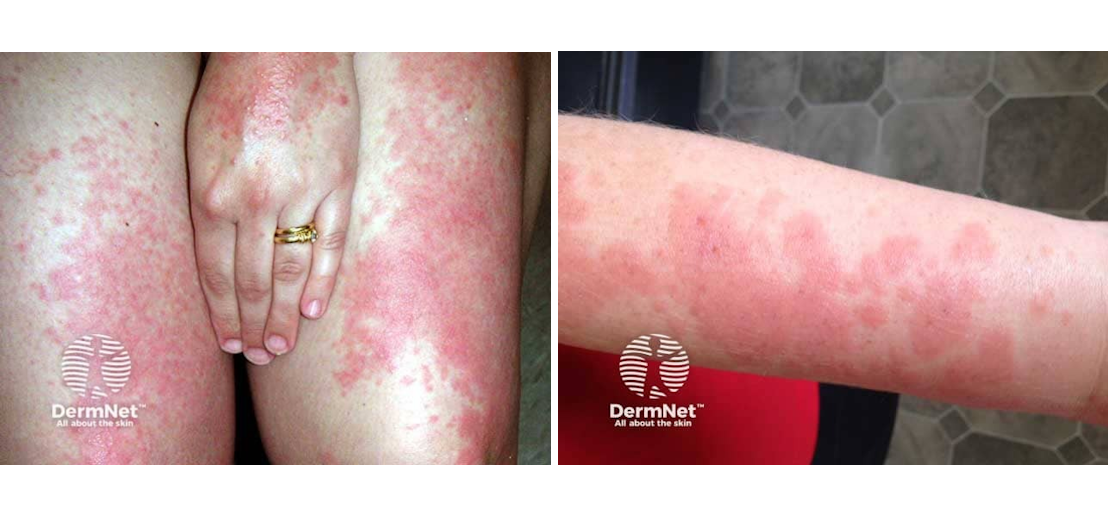
In polymorphic light eruption the lesions itch and can persist for up to a month. Source: DermNet
Polymorphic light eruption is far commoner than solar urticaria, and differs from it in that the lesions appear after a longer exposure to the sun and are slower to disappear. It is called polymorphic because the lesions are varied: macules, papules, blisters and even “target” lesions, accompanied by itching.
It usually begins before the age of 30, although there are cases beginning in childhood or later in adult life. It is twice as common in women as in men.
A characteristic pattern: it appears early in spring or at the beginning of summer and tends to improve over the course of the summer, as the skin adapts to exposure.
The eruption begins suddenly, with itching and sometimes even a stinging or painful sensation, 30 minutes or more after sun exposure. It can persist for a week and sometimes for up to 4 weeks, during which the symptoms gradually become less intense.
It is a long-lasting condition: the symptoms can return season after season for more than 20 years.
Actinic prurigo
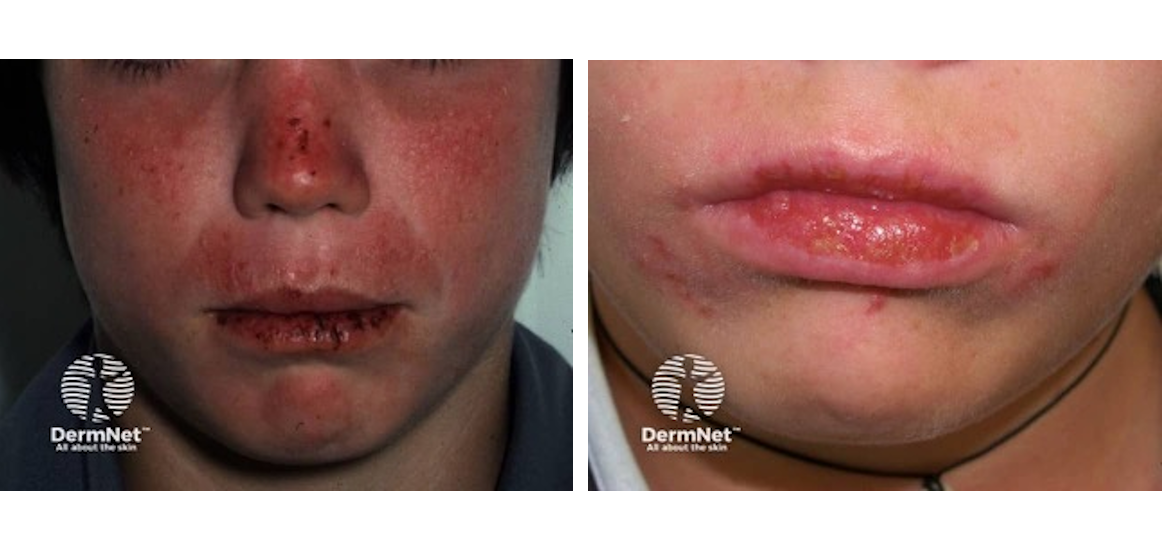
Actinic prurigo can appear on the face or the lips. Source: DermNet
The causes of sun allergy
The mechanisms differ between the two conditions.
In solar urticaria, the likely cause is an antigen-antibody reaction. Solar radiation can induce the appearance of an antigen in the patient's serum, which sets off an immune reaction mediated by IgE. This in turn leads to the degranulation of mast cells and the secretion of histamine, responsible for the itchy lesions.
In polymorphic light eruption, the cause is not fully understood. Several possible theories are cited:
- the production of neoantigens;
- an inability to induce apoptosis;
- reduced immune tolerance;
- a delayed hypersensitivity reaction;
- a disturbance of the skin microbiome.
Risk factors
Sun allergy can affect anyone, but certain factors increase the risk. They are:
- Family history: the risk is higher where the condition exists in other members of the family.
- Skin type: some forms are commoner in people with fair skin, others in those with darker skin. Polymorphic light eruption appears more often in women, in people with fair skin, in adolescents and in young adults.
- The season: reactions are commoner in spring and early summer, when sun exposure rises sharply. As exposure carries on through the summer months, the skin may become more resistant and the risk of a reaction falls.
- Certain medicines, which increase the risk of a photoallergic reaction: antibiotics, antifungals, antihistamines, cholesterol-lowering medicines, diuretics, hormones (including the contraceptive pill), non-steroidal anti-inflammatories and retinoids (widely used for acne and for their anti-ageing effect).
- Products applied to the skin: sunscreens, make-up and perfumes can react with sunlight and set off a photoallergic reaction.
How the diagnosis is made
The diagnosis is made by the dermatologist and rests on a few elements:
- the appearance and location of the lesions;
- the interval between sun exposure and the appearance of the eruption;
- how quickly the lesions disappear once exposure stops (an essential element for solar urticaria);
- the season and the pattern of recurrence;
- ruling out other conditions that produce eruptions after exposure to ultraviolet light (lupus, porphyrias, phototoxic reactions, heat rash).
For confirmation, the doctor may recommend phototesting, a procedure in which small areas of skin are exposed under controlled conditions to measured doses of UVA and UVB, in order to reproduce the reaction. Depending on what is suspected, blood tests may also be needed, to rule out an associated disease.
Treating sun allergy
The treatment is decided by the dermatologist and differs according to the kind of eruption and its severity.
Treating solar urticaria
- Mild cases: antihistamines.
- Moderate cases: desensitisation through phototherapy – narrowband UVB or PUVA.
- Severe cases, accompanied by systemic symptoms: sometimes even biological therapy.
Treating polymorphic light eruption
The most important measure remains prevention (set out in the next section). When treatment is needed, the dermatologist may recommend:
- antihistamines;
- antioxidants;
- topical or systemic corticosteroids, or treatment with calcipotriol;
- narrowband UVB phototherapy or PUVA;
- in selected cases, more complex treatment with synthetic antimalarials or immunomodulators.
None of these options is given without a medical assessment. An unsuitable treatment can delay the correct diagnosis of a more serious condition with similar skin manifestations.
Natural remedies for sun allergy
There is no natural remedy that cures sun allergy. There are, however, care measures that calm the symptoms during an episode:
- stop sun exposure
- apply cool, damp compresses to the affected areas
- keep yourself hydrated, drink plenty of water
- an over-the-counter antihistamine can ease the itching
- leave the blisters intact, do not break them, to avoid infection
What you should know about herbal remedies
Aloe vera, calendula, colloidal oatmeal baths and coconut oil are frequently recommended online. They may have a soothing effect, but they do not treat the mechanism that produces the eruption and they are no substitute for a dermatological consultation. What is more, some plants and essential oils (St John's wort, bergamot oil, citrus) are themselves photosensitising and can make the reaction worse.
The dermatologist may recommend antioxidants as part of the treatment plan. These are taken on a doctor's instructions, though, not on your own initiative.
When to see a dermatologist
Book a consultation if:
- the eruption appears every time after sun exposure
- the lesions persist for more than a few days;
- the eruption is extensive, painful or accompanied by fever
- the symptoms return season after season, year on year;
- you do not know whether the reaction is to the sun or to your sunscreen
How to prevent sun allergy
In polymorphic light eruption, prevention is the most important therapeutic measure. The basic recommendations are:
- Avoid exposure when the sun is at its strongest, between 10:00 and 14:00.
- Wear protective clothing, covering the areas prone to the eruption.
- Use broad-spectrum sunscreens, providing protection against ultraviolet A as well as B (UVA+UVB)
- Increase exposure gradually at the start of the season, rather than suddenly and at length.
If you have reacted to a sunscreen in the past, choosing the right product becomes all the more important and should be discussed with your dermatologist.
The Dermestetica doctor's advice
Sun allergy is the skin's way of telling us that it needs protection, not to be ignored. Enjoy the sun in moderation, use sun protection every day, and do not put off a dermatological consultation when your skin is telling you that something is wrong. – Dr Daniela Popoiu, specialist dermatovenereologist, Dermestetica
FAQ – frequently asked questions about sun allergy
Does sun allergy go away by itself?
The lesions of solar urticaria resolve completely within 24 hours of exposure stopping. Polymorphic light eruption can persist from a week to 4 weeks. The condition itself is chronic, though, and tends to return season after season, which is why prevention and medical assessment remain important.
What is the difference between solar urticaria and polymorphic light eruption?
Solar urticaria is rare, appears after less than 30 minutes of exposure and disappears completely within 24 hours. Polymorphic light eruption is far commoner, appears after a longer exposure, has varied lesions and is far slower to disappear.
Can sun allergy appear through clothing?
Yes. In solar urticaria the lesions can appear on areas covered by thin clothing, because it does not block ultraviolet radiation completely.
Is sun allergy the same as an allergy to sunscreen?
No. An allergy to sunscreen is a reaction to an ingredient in the product (most often a chemical filter), while sun allergy is a reaction to ultraviolet radiation. The two are easily confused, and the distinction is made by the dermatologist.
Can children have a sun allergy?
Yes. Although polymorphic light eruption usually begins before the age of 30, there are cases beginning in childhood.
Is sun allergy contagious?
No. The eruption associated with sun allergy does not pass from one person to another.
Does sun allergy leave scars?
As a rule, no. The eruption leaves no scars, unless you scratch and break the surface of the skin.
Can I have a sun allergy reaction through the window of a car or an office?
Yes, in certain cases. Ultraviolet B (UVB) does not pass through glass, but ultraviolet A (UVA) does. Photosensitive people can react to exposure through a window.
Which medicines increase the risk of a reaction to the sun?
Antibiotics, antifungals, antihistamines, cholesterol medicines, diuretics, hormones (including the contraceptive pill), non-steroidal anti-inflammatories and retinoids. Do not stop any treatment on your own initiative: talk to the doctor who prescribed it.
Can sun allergy be dangerous?
Rarely, but yes. Systemic symptoms can appear: headache, dizziness or fainting, nausea and vomiting, wheezing or difficulty breathing. With solar urticaria there is also a very rare risk of anaphylaxis, which calls for emergency medical attention.
Can sun allergy be prevented entirely?
No. Since the causes are not fully understood, there are no strategies that prevent the condition itself from appearing. The episodes can be prevented, though, through the measures described above.
At Dermestetica
We assess each patient in order to establish exactly which kind of skin reaction to the sun is involved and to rule out other conditions with similar manifestations. Depending on the diagnosis, we build a plan together that combines the right treatment with preventive measures suited to your skin type and your way of life.
Book a consultation and find out exactly what happens to your skin in the sun.
Sources
- Mayo Clinic – Polymorphous light eruption: https://www.mayoclinic.org/diseases-conditions/polymorphous-light-eruption/symptoms-causes/syc-20355868
- Mayo Clinic – Polymorphous light eruption: https://www.mayoclinic.org/diseases-conditions/polymorphous-light-eruption/symptoms-causes/syc-20355868
- British Association of Dermatologists. Polymorphic Light Eruption (PLE). https://www.bad.org.uk/pils/polymorphic-light-eruption
- British Association of Dermatologists. Solar Urticaria.https://www.bad.org.uk/pils/solar-urticaria
- EAACI/GA²LEN/EuroGuiDerm/APAAACI. The International Guideline for the Definition, Classification, Diagnosis and Management of Urticaria. https://www.aad.org/member/clinical-quality/guidelines https://onlinelibrary.wiley.com/doi/10.1111/jdv.17242
- MedlinePlus Medical Encyclopedia. Polymorphous Light Eruption.https://medlineplus.gov/ency/article/001477.htm