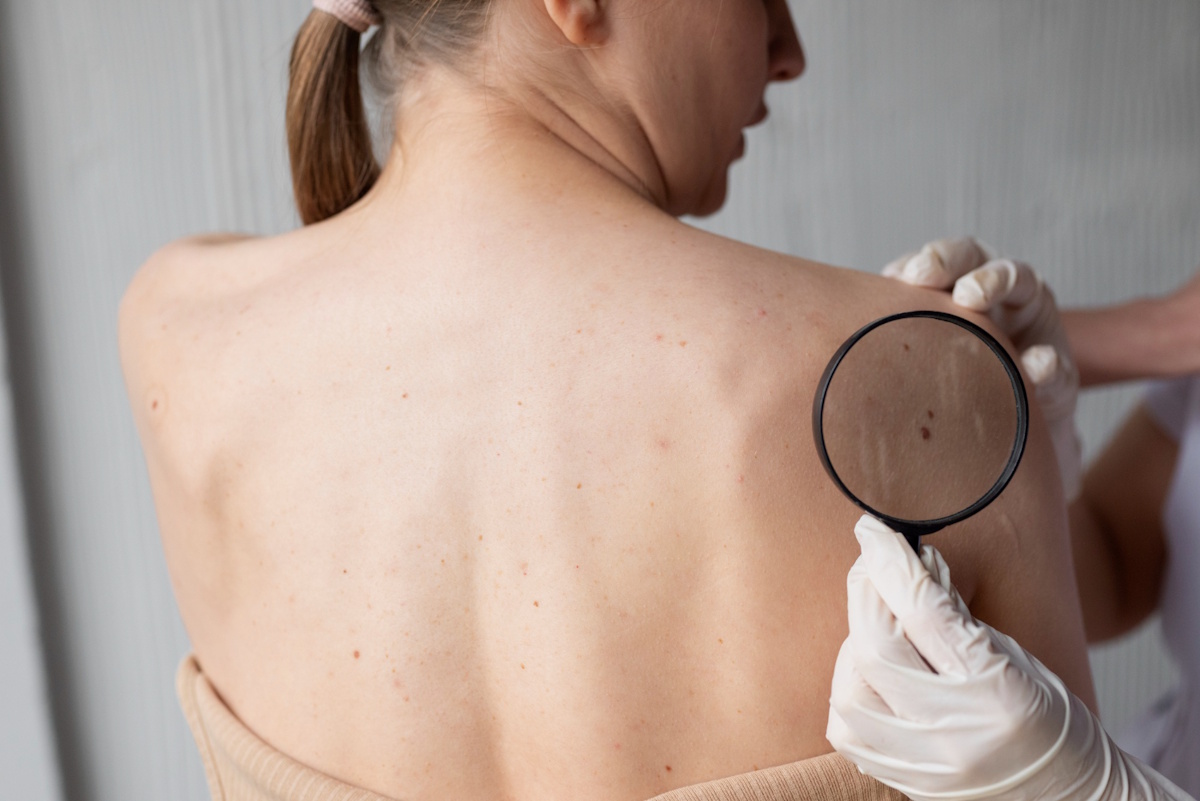

How to be rid of skin tags for good through safe medical methods: electrocautery, CO2 laser or radiocautery. Why removing them at home does not work.
Skin tags are among the commonest benign (non-cancerous) growths of the skin and, once they appear, they rarely go away without medical intervention. Although they are no danger to health, they can become unsightly or awkward, especially where the skin often rubs against clothes or accessories. Removing them is a simple, quick procedure, carried out by the dermatologist in the clinic.
In this guide we explain what skin tags are and why they appear, where they appear most often, when it is time to see a doctor, what treatments exist, why trying to remove them at home is not advisable, and what you should know about caring for the skin after the procedure, so that you can say: I am rid of them.
What skin tags are
Skin tags are small, soft growths of the skin, usually skin-coloured or slightly darker. Many of them hang by a thin thread of skin, and their size ranges from a millimetre to a few centimetres. In medical language you will find them under the names acrochordons or fibroepithelial polyps, but everybody calls them skin tags.
They are made up of soft tissue, collagen and a few fine blood vessels, covered by a thin layer of skin. That is why they are soft to the touch and can bleed if you catch or scratch them by accident. The statistics show that about half of all adults have at least one skin tag at some point in life, and after the age of 40 they become commoner still.
Skin tags are entirely benign. They do not turn into cancer and they do not put your health at risk. The problem is that they look like other growths on the skin, some of them more serious, and only a doctor can tell the difference. That is why the first step is always a dermatological consultation, completed where necessary with digital dermatoscopy.
The causes of skin tags
Skin tags appear when the body produces an excess of cells in the superficial layers of the skin. Research has identified the HPV virus (human papillomavirus) in a high proportion of biopsies of skin tags, which suggests a viral component in how they form. The strains involved are generally non-oncogenic, different from those associated with serious disease.
What HPV means in the case of skin tags
HPV is a family of over 100 different strains. Simplified, they fall into two categories:
- High-risk (oncogenic) strains – these are the ones responsible for pre-cancerous lesions and for cervical cancer. There is vaccination against them, and screening programmes.
- Low-risk strains – these are the ones that produce ordinary skin lesions, such as skin tags and common warts. They do not cause cancer.
In other words, having skin tags on your neck or under your arm has nothing to do with the dangerous forms of HPV and does not mean you have an infection carrying a cancer risk. They are two entirely different situations, even though the virus bears the same name.
The factors that encourage skin tags
Skin tags usually appear when several factors come together:
- the skin rubbing repeatedly against itself, or against clothes, accessories or jewellery
- excess weight, which increases the number of skin folds prone to friction
- pregnancy, because of the hormonal changes (high levels of oestrogen and progesterone)
- insulin resistance and diabetes, multiple skin tags being a possible skin marker of metabolic disorders
- a weakened immune system
- genetic predisposition, skin tags often being a problem found in several members of the same family
Once one skin tag has appeared, other similar growths frequently develop in the same area, especially if the friction that encouraged it remains unchanged. For this reason many patients come to the clinic not with a single lesion but with a group of skin tags formed over time.
Where skin tags appear most often
Skin tags develop mainly in the areas where the skin rubs constantly, either against itself or against clothes and accessories. Most often you will find them on:
- the neck
- the underarms
- the eyelids
- the area under the breasts
- the groin
Where a skin tag appears influences the choice of treatment. Skin tags on the eyelids, for example, call for a more precise approach because of the closeness of the eye and the very thin skin there, while those on the neck or under the breasts may have more treatment options.
Skin tag, mole, wart or seborrhoeic keratosis? How to tell them apart
Not everything that appears on the skin is a skin tag. The commonest confusion is with moles and warts, and the difference genuinely matters: each kind of lesion has a different treatment, and some call for investigation before any intervention.
| Kind of lesion | What it looks like | What you should know |
|---|---|---|
| Skin tag | Soft, hangs from the skin, skin-coloured or light brown, with clear edges | Benign, appears in areas of friction, does not go away by itself |
| Mole | Fixed in the skin, flat or slightly domed, pigmented | Needs monitoring; irregular borders or several colours mean urgent assessment |
| Wart | Hard, rough to the touch, sometimes with black dots on the surface | A viral lesion, common on the hands and soles, and contagious (it can spread) |
| Seborrhoeic keratosis | Looks “stuck on” the skin, with a waxy surface, brown to black | Benign, appears with age, easily confused with a pigmented lesion |
Worth knowing: skin tags do not go away by themselves. Warts, on the other hand, particularly in children, can regress after a while. If a growth persists for months or years in the same area of friction, the chances are high that it is a skin tag. For a diagnosis you should see a dermatologist, who will examine you and prescribe the right treatment.
When multiple skin tags are a metabolic signal
Studies have shown a link between skin tags and insulin resistance, type 2 diabetes, raised cholesterol and obesity. Some researchers consider them an early marker, that is, a sign appearing on the skin before other symptoms become obvious.
That does not mean every skin tag points to a problem. The signal appears when skin tags multiply rapidly, are numerous and in several areas, and are accompanied by other skin signs, such as thickened, darker skin in the folds.
In such situations the dermatologist may recommend some simple tests, for blood sugar and a lipid profile.
What happens if you leave a skin tag untreated
Skin tags do not become cancerous, so putting off treatment does not put your life at risk. There are, however, a few practical consequences worth knowing:
- They multiply. They do not go away by themselves and, in areas of friction, others appear around the existing ones.
- They grow. A small skin tag, easily dealt with in a single session, can after a few years reach a size that calls for a more complex procedure and a longer recovery.
- They can twist. Skin tags that hang can twist around their own base. When that happens the blood supply stops, the skin tag becomes painful, darkens and can become infected.
- They become irritated and bleed. Repeated rubbing leads to inflammation and small bleeds, sometimes followed by infection.
- They make monitoring the skin harder. The more growths you have, the harder it is to notice a new one, different in appearance, that would deserve attention.
The best moment to have them removed is while the lesions are small. The procedure takes less time, healing is quicker and the aesthetic result is better.
Skin tags in pregnancy
Skin tags appearing in pregnancy are common and have a simple explanation. High levels of oestrogen and progesterone, weight gain and changes in the volume of the body create exactly the conditions in which skin tags develop: more folds, more friction and a favourable hormonal ground.
They most often appear on the neck, under the breasts, in the underarms and in the groin. Many of them remain after the birth, although some shrink once the hormones and the weight return to normal.
Removal procedures are usually postponed until after the birth and the period of breastfeeding, except where a skin tag twists, becomes infected or causes considerable discomfort. Local anaesthesia and minimally invasive procedures are not categorically forbidden in pregnancy, but the decision belongs to the doctor, after an individual assessment. Until then, you can reduce the discomfort by wearing loose clothes and giving up the accessories that irritate the affected areas.
When you should see a doctor
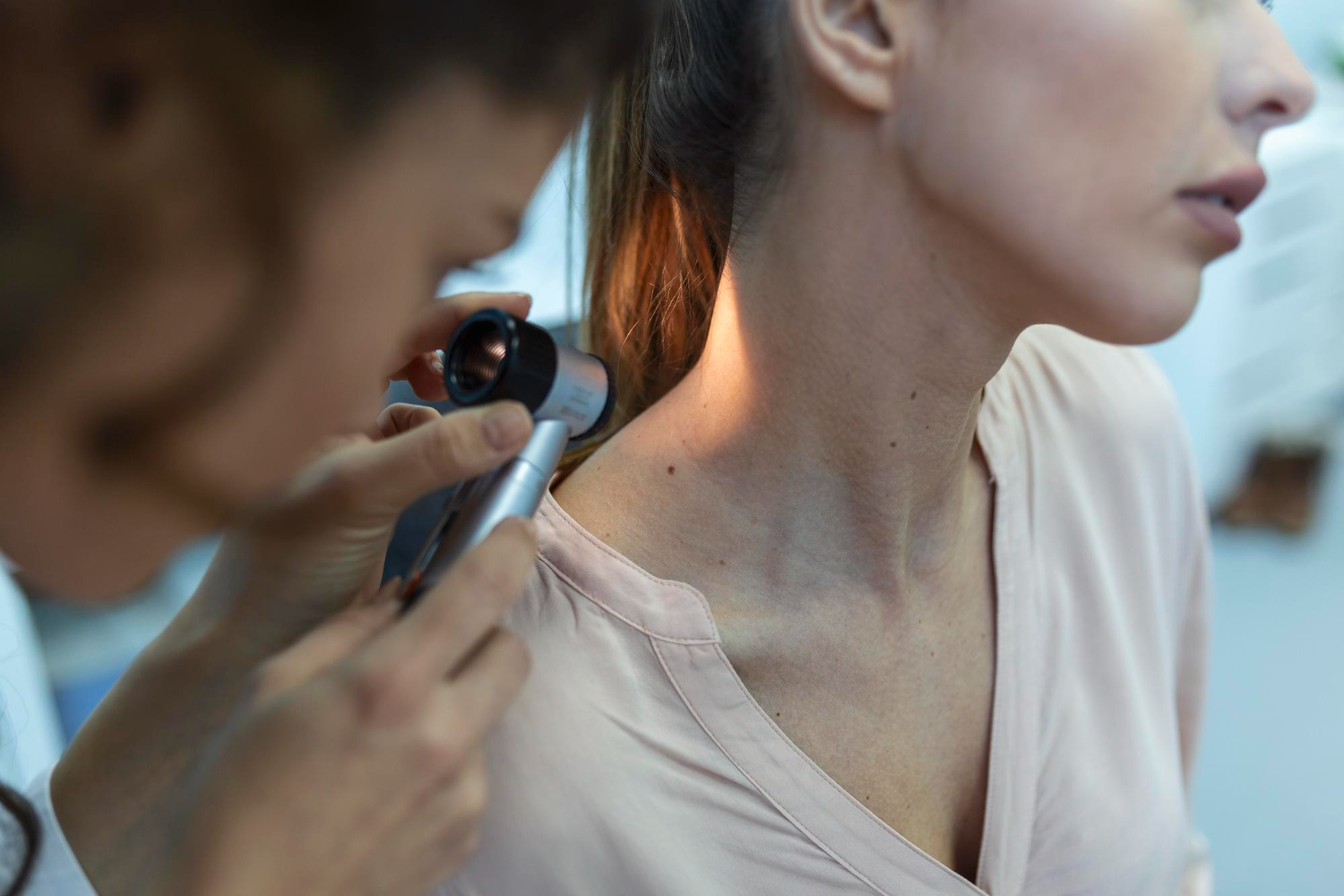
At the consultation, the doctor may use a dermatoscope to establish exactly which kind of lesion you are dealing with
Although most skin tags are harmless, certain signals show that you need a dermatological assessment as soon as possible. These are the symptoms that should send you to a doctor:
- the skin tag suddenly changes colour
- it grows rapidly
- it bleeds without having been knocked
- it becomes painful or inflamed and does not settle
- it has irregular borders or an uneven appearance
- many new lesions appear, in several areas, over a short period
Where the clinical appearance raises questions, the doctor may recommend a skin biopsy with histopathological examination, the only method that gives a definite diagnosis.
Even without these warning signs, a dermatological check helps when the number of skin tags visibly increases or when they begin to affect your everyday comfort. If you have many skin lesions, a digital dermatoscopic map allows changes to be monitored over time.
Treatment: how to be rid of skin tags
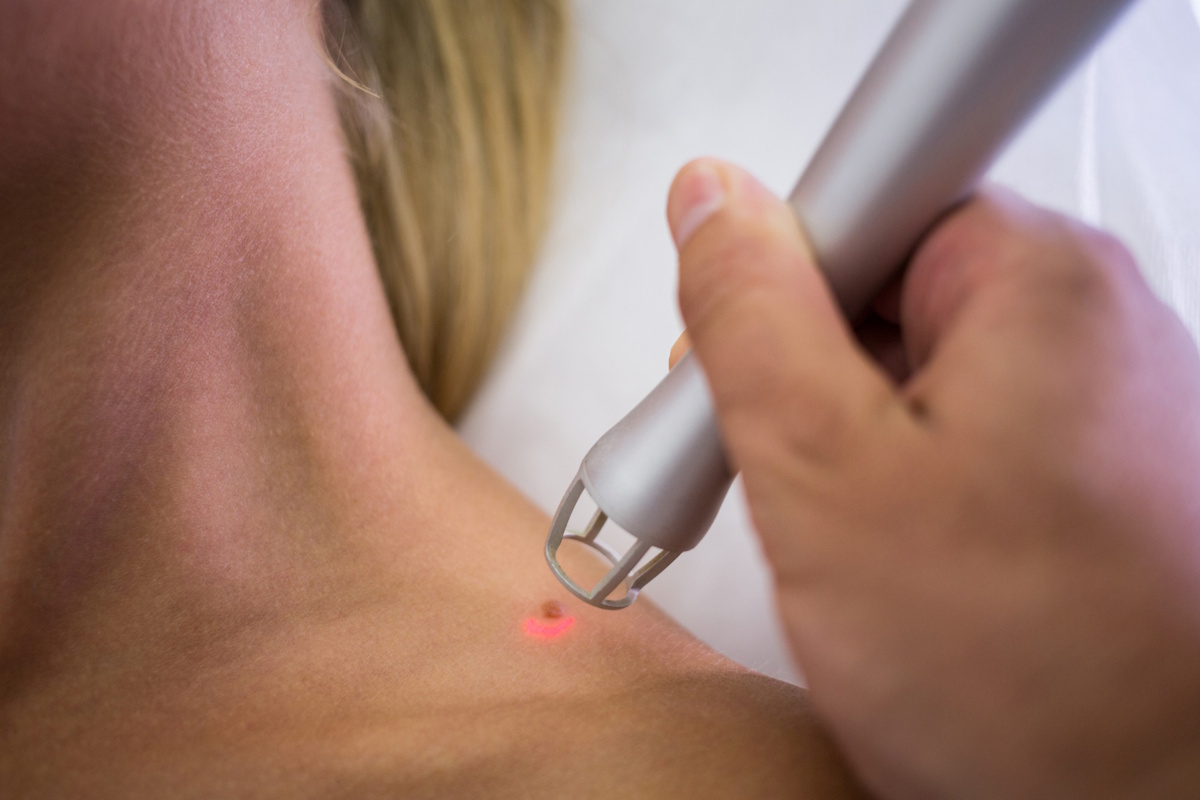
Removing skin tags at the dermatologist is safe and precise
The only way to be rid of a skin tag for good is to have it removed through a medical procedure, such as electrocautery, the CO2 laser or radiocautery. At Dermestetica the doctor establishes the right method after a dermatological assessment, according to the size, the location and the number of lesions. These are the treatment options and how each one works:
| Method | How it works | Recommended for |
|---|---|---|
| Electrocautery | A high-frequency electric current burns the skin tag and stops the bleeding on the spot | Small and medium skin tags, single or multiple |
| CO2 laser | The beam of light vaporises the affected tissue with great precision, without harming the surrounding skin | Skin tags in sensitive areas, such as the eyelids or the neck |
| Radiocautery | Radio waves cut and cauterise at the same time, with minimal heat around the lesion | Cases where the aesthetic result matters most |
| Surgical excision | The doctor removes the skin tag with a scalpel, under local anaesthesia | Large skin tags, or situations calling for examination under the microscope |
An important advantage of the medical procedures is that the doctor removes the tissue down to the base. The skin tag therefore does not re-form.
How the procedure goes at the clinic
It all begins with a consultation, in which the doctor examines the lesion with the naked eye and, where appropriate, with the dermatoscope. Dermatoscopy shows the structure of the skin tag magnified, which helps distinguish it from other similar growths.
Once the diagnosis is confirmed, the doctor chooses the method and explains step by step what comes next, including how to care for the skin at home. The procedure usually takes place the same day, under local anaesthesia. The discomfort is minimal, about as much as a brief sting.
The procedure takes between a few minutes and half an hour, depending on how many lesions are treated and on the method chosen. Afterwards you go back to your normal activities the same day, following the instructions you have been given.
Caring for the skin after skin tags are removed
The final result depends not only on the procedure but also on how you care for the skin in the days that follow. The recommendations are simple:
- keep the area clean and dry for the first few days
- keep the area out of the sun and use a high-SPF product
- apply a healing cream, if your doctor has recommended one
- leave make-up and cosmetics off the treated area until it has healed
- do not scratch or pull off the crust before it falls away by itself
- avoid products with acids or retinol on that area
What healing looks like, day by day
| Period | What happens | What to do |
|---|---|---|
| Day 1 | Slight redness, sometimes a smarting sensation | Keep the area clean and dry, avoid intense effort |
| Days 2–3 | A thin crust forms | Do not touch it, apply the recommended cream |
| Days 5–7 | The crust begins to fall away by itself | Leave it alone, carry on with sun protection |
| Days 7–10 | New skin appears, slightly pink | SPF daily, no irritating products |
| After 2–3 months | The pink shade evens out with the rest of the skin | Sun protection still, especially in summer |
Newly formed skin reacts far more strongly to the sun, and unprotected exposure leaves dark marks that persist for months. You will find more about choosing the right product in our guide to sun protection.
Myths about removing skin tags
“After the procedure I am rid of the virus and they will never come back”
The procedure removes the lesion, not the virus in the body, nor the factors that led to it appearing. The skin tag treated does not come back, but others can appear, particularly if the friction carries on.
“It hurts a great deal and is done without anaesthetic”
The procedure is carried out under local anaesthesia, and during it you feel at most a slight pressure. Afterwards there may be a smarting sensation, which passes quickly.
“It leaves large, ugly scars”
Done properly, on small lesions, the procedure leaves at most a temporary pink area, which evens out over a few months. Scars come rather from attempts at home.
“If I wait, perhaps they will go away by themselves”
Skin tags do not regress spontaneously. Over time they grow or multiply, and treating them becomes more laborious.
“I have heard of a cream that dries them up in three days”
Over-the-counter creams and solutions are not designed for skin tags, and applied wrongly they can burn healthy skin. What is more, no product can do what the doctor does first of all: confirm that what you have really is a skin tag.
Why removing skin tags at home is not advisable
“Removing skin tags at home” is a much-searched phrase on the internet, but improvised solutions usually do not solve the problem. Here, the risks to the skin are considerable. This is what can happen if you try to remove a skin tag at home:
- bleeding you cannot stop, especially in areas with many blood vessels
- infection, when you use scissors or other non-sterile objects
- scars and dark marks, particularly after the chemical burns caused by kitchen remedies
- cutting or burning a lesion that was not a skin tag, and losing the chance of a correct diagnosis
- the skin tag comes back, because the tissue has partly remained in the skin
There are also pharmacy products, such as salicylic acid solutions or home cryotherapy kits. They look more serious than improvised remedies, but they are made mainly for warts. On skin tags they can irritate or damage the healthy skin around them. That is why any skin lesion should be assessed and treated only by a doctor.
Preventing further skin tags
Skin tags cannot be prevented entirely, because they also depend on factors outside your control, such as genetics or a virus already present in the body. A few simple steps do reduce the risk, though:
- choose clothes and accessories that do not rub the skin in the areas prone to them
- keep the skin folds clean and dry
- manage your weight, if extra kilos are a factor in your case
- check your blood sugar, particularly if you have insulin resistance or diabetes
- look after your immunity through a balanced way of life
- have regular dermatological checks
If you have already had multiple skin tags, the chances of others appearing are higher. Regular checks help you have them removed while they are small, when the procedure is simple and the aesthetic result better.
The price of skin tag removal
The price varies with the method chosen, the number of lesions and where they appear. Multiple skin tags treated in the same session usually work out cheaper per lesion than a single one treated on its own.
Here are a few examples:
| Skin tag removal procedure | Price |
| Radiocautery, under 5 lesions | 390 lei |
| Radiocautery, 6–10 lesions | 490 lei |
| Radiocautery, 10–50 lesions | 600 lei |
| Radiocautery, over 50 lesions | 800 lei |
You will learn the exact cost at the consultation, once the doctor has assessed the lesions and recommended the right method. The full price list is in the Dermestetica prices section.
The Dermestetica doctor's advice
”Viral papillomas are often seen as an aesthetic problem, but they are the expression of a viral infection. Dermatological assessment matters both for establishing the correct diagnosis and choosing the treatment and for preventing spread and recurrence. Their treatment consists of thermal destruction under local anaesthesia, and aftercare is very straightforward. People who develop papillomas have local conditions that suit the virus and may develop lesions again after they have been treated, so periodic dermatological assessment and treatment of these lesions is needed”. – Dr Daniela Popoiu, specialist dermatovenereologist, Dermestetica
Frequently asked questions about removing skin tags
Will I be able to say “I am rid of them”?
Yes; after a procedure properly carried out by a doctor, that skin tag is gone for good. Others may appear over time if the risk factors remain, which is why regular checks help you keep the situation under control.
Does the removal procedure hurt?
The discomfort is minimal. The procedure is carried out under local anaesthesia, and patients usually describe only a sting or a sensation of warmth.
Do skin tags come back after removal?
The skin tag removed does not come back. New ones may appear in the areas prone to them, though, because the procedure treats the lesion, not the causes that led to it forming.
How long does healing take?
Between 7 and 10 days for complete healing, depending on the method used and on where the skin tag is.
How many skin tags can be treated in one session?
There is no maximum. The number depends on the method and the area, and the doctor establishes at the consultation whether several sessions are needed.
Is it safe to remove skin tags from the eyelids?
Yes, if the procedure is carried out by a dermatologist, with a precise method such as radio waves, suited to the sensitive areas of the face.
Do scars remain after skin tags are removed?
Normally, no. The modern methods leave minimal marks or none at all, if you follow the instructions given afterwards. For scars that already exist, the clinic offers dedicated treatments.
Are skin tags contagious?
Skin tags are not caught through ordinary contact between people. They can multiply on the same person's body, though, in areas of friction.
Can skin tags be removed in summer?
Yes, provided you protect the treated area well from the sun in the following weeks. Newly formed skin pigments easily, so SPF becomes obligatory. Otherwise, the ideal time to have skin tags removed is the cold season.
In conclusion
Skin tags are not dangerous, but they can become a constant discomfort, especially when they appear where the skin rubs. Removing them at home looks like a quick solution, but it comes with the risk of infection, scarring or the lesion coming back.
A medical procedure, suited to the size of the skin tag and to where it is, is the safe way to say, truly, “I am rid of them”. The first step is a dermatological consultation, in which the doctor confirms the diagnosis and recommends the method that suits your case.
Sources
- American Academy of Dermatology – Skin tags: Why they develop, and how to remove them
- Cleveland Clinic – Skin Tags (Acrochordons): Causes, Locations, Treatment
- A Clinico-Morphological Study of Acrochordons and the Association With Diabetes Mellitus (PMC)
- Medscape – Acrochordon: Practice Essentials, Pathophysiology, Etiology