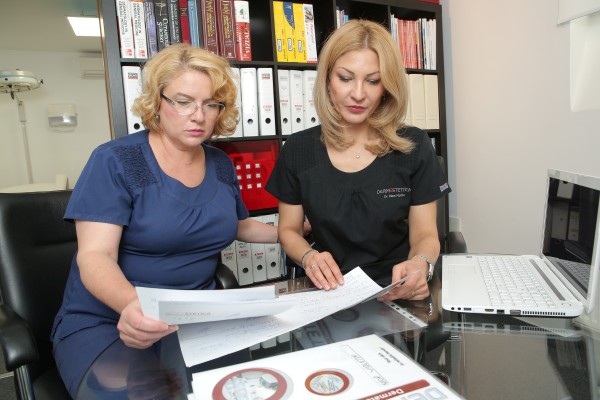
Ever since I was little I dreamed of becoming a doctor. My love of dermatology appeared at university, thanks to the brilliant and dedicated teachers I had.
-
For eleven years you have been “in the service” of health and beauty. Is becoming a dermatologist a dream come true, or was it simply meant to be?
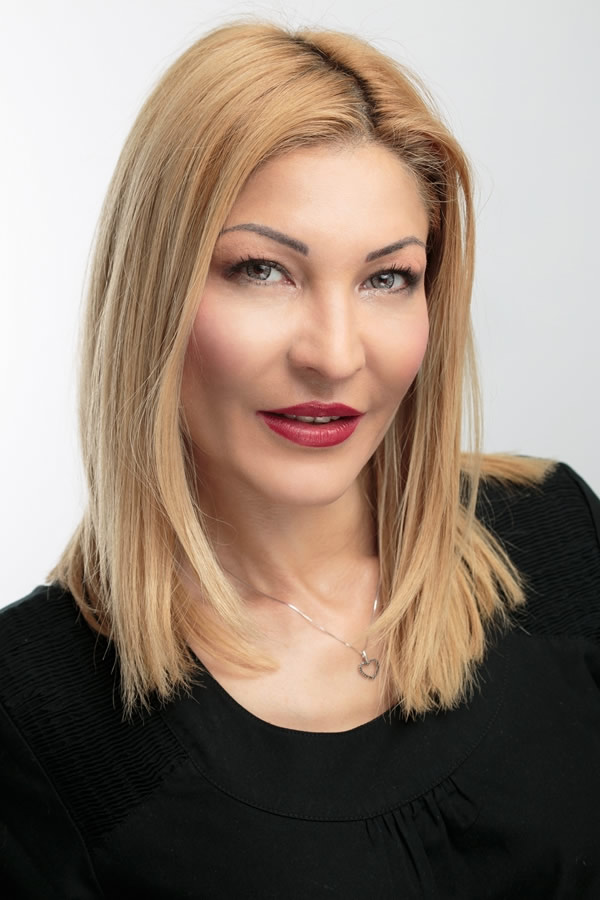 Ever since I was little I dreamed of becoming a doctor. My love of dermatology appeared at university when, thanks to the brilliant and dedicated teachers I had, combined with the fact that I had skin problems myself, I began to study this speciality and go deeper into it. During my residency, again, I had exceptional mentors, from whom I understood that dermatology does not mean simply looking at a patient's skin and writing a prescription. The skin can be the first messenger of more serious conditions, which is why you have to look and think beyond the skin barrier, integrate the information you receive, assess the patient individually and as a whole, and have the patience to listen to them. Skin signs often precede the onset of other conditions by years, so the dermatologist can be a providential rescuer in certain situations.
-
What does a doctor need in order to be a professional in dermatology?
First of all they have to be very well trained. Treatments in dermatology, as in many specialities, evolve from year to year. To keep up with everything that appears around the world you have to attend, at least twice a year, the international and world conferences of the major bodies in the field, where the results of the past year's research are gathered and shared. Being always up to date calls for a great investment of time and money.
Not least, you need a great deal of patience, availability, attention and concentration, honesty, and the strength to set aside everyday problems in order to give your full attention and care to the patient in front of you.
-
How was Dermestetica “born”, and what is the story of this clinic?
During my residency I saw myself doing nothing other than walking the hospital wards, caring for the patients admitted there. When I became a specialist I began working in the state system. For a few months I was very happy that I was finally a dermatologist, that I was doing what I love. Soon, though, I came up against the shortcomings of the system.
At the same time I began travelling often to conferences and various courses at state and private clinics in other countries. I could not help making comparisons. The difference was between heaven and earth. I too would have liked to work with the latest technology, with advanced equipment, and not to have to think about “saving on gloves, gauze and syringes”. So in 2006 I decided, almost recklessly, since I knew nothing about entrepreneurship, to open my own clinic. I took out a lease on the first laser, a very, very expensive one, for which I guaranteed with everything the family owned. The sleepless nights of worry in that period made me understand that I had set out on a risky, hard road with no way back. Since then I have only gone forward, and here we are with a wonderful team of doctors and nurses, with only top equipment, and with many patients who keep coming back, confident that we can always help them with their problems.
-
What is Dr Dana Popoiu's main role within the clinic? How do you combine management with seeing patients, and what can you tell us about the Dermestetica team?
First of all my role is that of a dermatologist. It is true that administrative and organisational matters take up a good deal of my time and attention, and it is getting harder and harder to find solutions to them, because the more we grow the more the problems grow too. Administrative subjects tire me and demand a great deal, and I feel I relax when the consultations and the procedures begin.
-
Do you love medical procedures more, or aesthetic ones?
I love them both equally. I have often asked myself whether it would be wise to give up one of them, but the answer has been categorical every time: no. They are bound up with one another; you cannot do aesthetics if you do not know dermatology and anatomy, if you have no sense of beauty and proportion.
-
You have said: “just as the eyes are the mirror of the soul, the skin is the mirror of physical and mental health”. Which factors harm our skin and make it ill the most?
What attacks us: stress, the sun and smog (pollution), empirical treatments picked up by ear or from the internet, lack of sleep, smoking. What does us good: proper care on a doctor's advice, sport or walks in the open air, rest, a healthy diet and mental balance.
-
How much importance do you think a woman should give her skin? From a medical as well as an aesthetic point of view? And a man?
For me beauty of the soul matters more than physical beauty. Even so, we live in an age of beauty ideals. Studies have shown that people who are beautiful, young and well groomed (by existing standards, of course) have a better chance of succeeding in life. I encourage natural beauty rather than beauty to a template, which is why I advise the patients who tell me they want to look like some model or other to think again.
Clean, young, toned and well-cared-for skin with the right volumes is more appreciated than large lips or perfectly smooth skin with not a single wrinkle but marked by the sun.
We have more and more male patients who want advice on skincare or who ask for procedures to rejuvenate and maintain the skin, and I think very highly of them. We cannot yet offer “eternal youth”, but we can offer the alternative of ageing beautifully.
-
We already talk about trends and fashion in cosmetic treatments and aesthetic corrections. Where is the line between care, maintenance and small corrections, and hidden frustrations?
At the consultation my first question is: what bothers you, or what would you like corrected? After listening carefully I tell the patient what the real problems are. Often these are nowhere near the reason for the visit, either because they have not been noticed or because the patient does not know they can be resolved. Aesthetic advice begins with the care methods to be adopted, or the procedures indicated, in order to have healthy skin first of all, young and radiant, so that we can then make the small aesthetic corrections if they are needed.
Wishes are often exaggerated, or expectations unrealistic, which is why the first consultation is essential.
-
Which are the most requested aesthetic procedures at the Dermestetica clinic?
Every aesthetic procedure has its place. I would say that all the procedures we carry out are effective and have remarkable effects on various conditions. We have always chosen top equipment. Even so, if I had to draw up a ranking, injections with botulinum toxin and fillers would be at the top.
-
What are the newest and most modern techniques, procedures and machines you use in treating the skin?
We have a fractional CO2 Ultra Pulse Encore Lumenis laser (the most advanced fractional CO2 technology, used to treat problems of skin texture, post-acne, post-burn and post-surgical scars, fine and moderate wrinkles and skin dyschromia), an Nd:YAG Cutera laser used to treat cutaneous venectasias and for permanent hair removal on darker phototypes, a Cocoon diode laser for permanent hair removal, an Ellman radiocautery unit (used for radiosurgery and for treating wrinkles with radiofrequency), a Fotofinder digital dermatoscope used to diagnose and monitor pigmented skin lesions, two microdermabrasion machines, and the DermaPen, the brilliant successor to the dermatological roller. All this equipment helps us in our daily work, but what matters most is that we use all our knowledge and a great deal of heart in what we do. I firmly believe that this recipe is the key to a clinic's success and longevity.