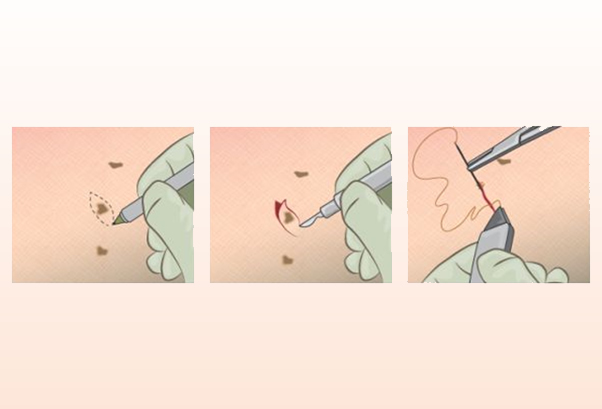
Surgical excision means the complete removal of a skin lesion. The commonest approach is an elliptical excision with the edges of the wound sutured, leaving a linear scar.
What is the surgical excision of a skin lesion?
Surgical excision means the complete removal of a skin lesion. The commonest approach is an elliptical excision with the edges of the wound sutured, leaving a linear scar.
Why is it a good idea to have a lesion removed?
Most often, excision is carried out to remove skin cancers (melanoma, basal cell carcinoma, squamous cell carcinoma and so on) or atypical lesions that may turn malignant. If a malignant lesion is not removed, it can spread or metastasise to other parts of the body. Other reasons for surgical excision include: a biopsy for diagnosis, the appearance of the body, and lesions that are symptomatic (painful) or sit where they are chronically traumatised (under a belt or a strap, over a bony prominence).
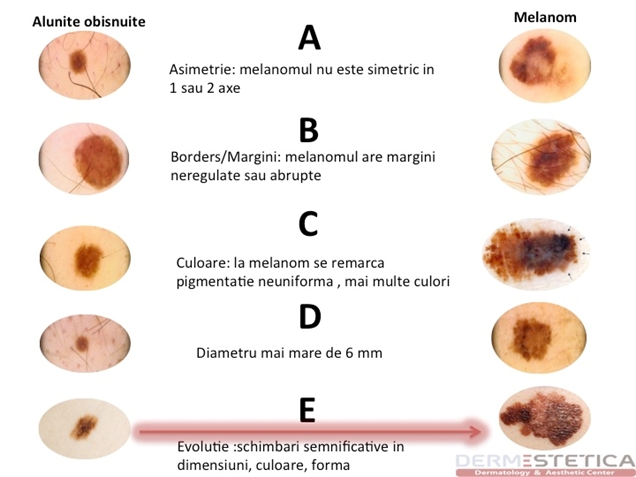
At the risk of repeating ourselves, we would remind you that people with many moles, or with atypical moles (those showing the ABCDE features: asymmetry, irregular borders, uneven colour, a diameter over 6 mm, and change over time in size, colour or shape) need a dermatoscopic map, which allows their moles to be monitored regularly.
Moles that show changes in structure and/or size at the periodic dermatoscopic check, and those with malignant features, are indicated for surgical excision with histopathological examination.
It is not advisable to excise every atypical naevus; the correct approach is to monitor them dermoscopically.
Will I be left with a scar?
It is impossible to cut the skin without leaving a mark, so there is always a scar, more or less visible.
The quality of the scar depends on where it is on the body, on the size of the excision, and on how each person heals. Some people respond excessively in the healing process and develop unsightly scars (hypertrophic or keloid).
What does surgical excision involve?
Your dermatologist will explain why it is a good idea for the lesion to be excised and what the procedure involves. You may be asked to sign a consent form stating that you have understood how it will go and that you agree to the surgical procedure. Tell the doctor if you are taking any medication (aspirin, heparin or anything else that interferes with blood clotting), or if you have any known allergy, medical condition or implant. The doctor also needs to know whether you are taking nutritional supplements or any natural remedies.
The commonest excision is the elliptical one. The long axis of the ellipse is oriented along the skin's relaxed tension lines, so that the resulting scar is as inconspicuous as possible.
The area is marked with a pen, then the local anaesthetic is given, which takes effect quickly and lasts throughout the procedure and for 1 to 2 hours afterwards.
The doctor will cut with a scalpel around and beneath the lesion, with a margin of 2 mm (generally). The specimen is then placed in formalin and sent to the histopathology laboratory, where the pathologist will examine it under the microscope and issue a report with the definite diagnosis a few days later.
The doctor will then suture the wound, leaving a line of stitches.
Sterile surgical strips and a waterproof dressing are applied, to be kept on for between 5 and 14 days (as the doctor directs).
Once the stitches are removed, a line will remain, reddish and raised at first, which will flatten and fade over the following months.
Certain raised benign lesions may be suitable for a so-called “shave biopsy”, which involves removing the lesion from the surface of the skin with a blade, examining it histopathologically and then cauterising the base. In this way we have histopathological control over every lesion removed.
Other benign lesions (such as viral papillomas, seborrhoeic keratoses, angiomas, angiokeratomas and common warts) can be removed by radiocauterisation or CO2 laser, without the need for histopathological examination.
They are destroyed with radio waves or with the CO2 laser beam, leaving an area of superficial burn that heals by forming a small crust, which falls away over the days following the procedure.