What is psoriasis? How it appears, how it shows itself and what kinds of treatment exist. Common questions about psoriasis.
Psoriasis is a chronic inflammatory disease of the skin, non-contagious, which affects roughly 2 to 3% of the world's population and for which there is at present no definitive cure. The disease shows as raised, well-defined red plaques covered by thick, pearly-white scales, the result of an excessively rapid proliferation of the skin cells. With proper dermatological management, though, the symptoms can be controlled effectively, and periods of remission can last for years.
What is psoriasis?
Psoriasis is a chronic inflammatory, immune-mediated skin disease with a strong genetic predisposition. Normally the skin cells renew themselves completely every 28 to 30 days. In psoriasis this process accelerates dramatically, to only 3 or 4 days – the keratinocytes accumulate at the surface, forming the thick, red plaques covered by silvery scales that are characteristic of the disease.
Psoriasis usually affects the skin of the elbows, the knees and the scalp, but it can appear on the rest of the skin, on the mucous membranes, on the nails and in the joints.
The spectrum of this disease ranges from mild, with limited involvement of small areas of skin, to severe psoriasis with large, thick plaques, and as far as the skin of the whole body being affected. Psoriasis is considered a chronic inflammatory condition that runs in flares. Its course varies, with periods of remission and periodic exacerbations. It is not unusual for psoriasis to clear spontaneously and remain in remission. Many people notice their symptoms worsening in the colder winter months or under intense stress.
The condition can appear in all races and in both sexes. Although psoriasis can be seen in people of any age, from infants to adults, patients are most often first diagnosed in adulthood. The self-esteem and the quality of life of patients with psoriasis are often reduced because of the appearance of the skin.
Recently it has been found that people with psoriasis are more likely to have diabetes, raised blood lipids (dyslipidaemia), cardiovascular disease and a variety of other inflammatory conditions. This may reflect an inability to control inflammation. Caring for psoriasis calls for teamwork involving several medical specialities.
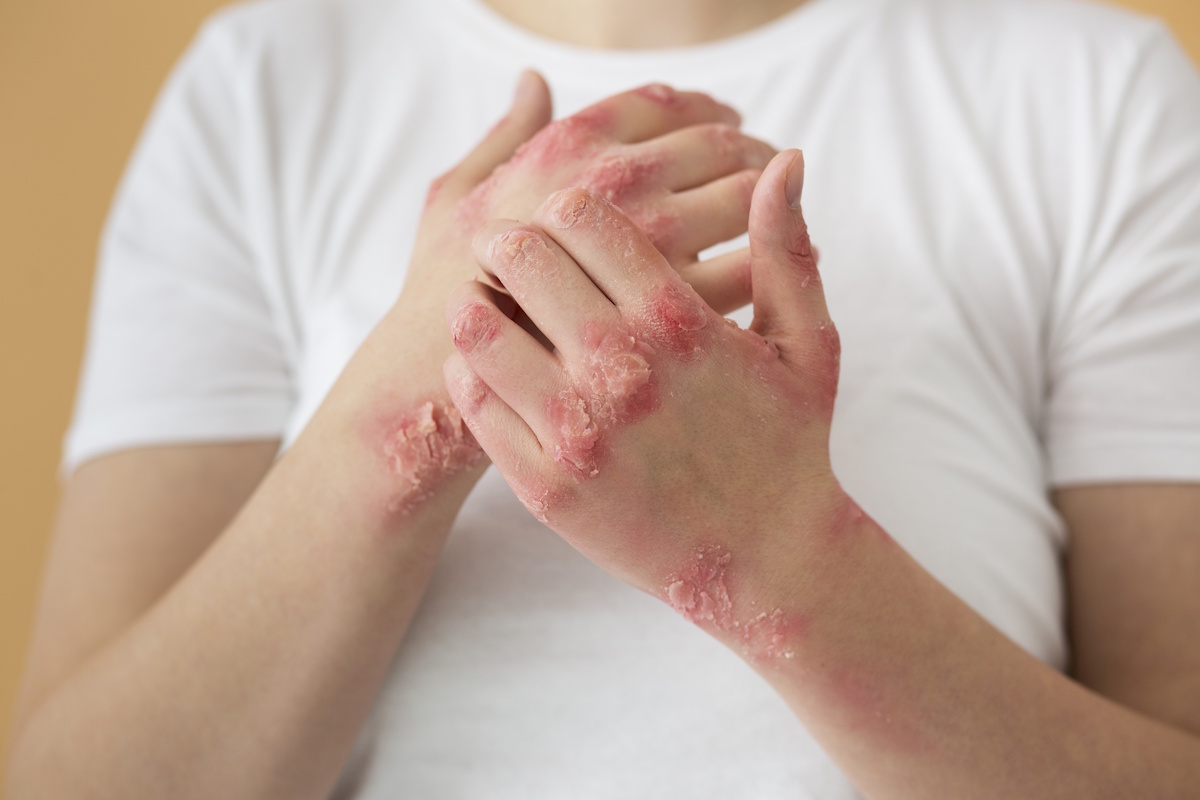
Psoriasis vulgaris (plaque psoriasis) accounts for 80 to 90% of cases and often appears on the backs of the hands, the elbows and the forearms. Well-defined red plaques covered by silvery scales are the characteristic sign of the disease. Photo: Freepik
What are the causes of psoriasis and the risk factors?
The exact cause of the disease remains unknown. A combination of elements is involved, including genetic predisposition and environmental factors. Psoriasis is frequently found among members of the same family. Defects in the immune system and in the control of inflammation are thought to play important parts. Certain medicines, such as beta-blockers, anti-inflammatories or lithium salts, have been linked to exacerbations of psoriasis. Despite the research carried out over the past 30 years, the “master switch” that sets the disease off is still being sought.
Common triggers
There are a number of well-documented triggers that can set off the first flare or make the disease worse in people already diagnosed:
- intense psychological stress – one of the commonest triggers; it creates a vicious circle, since the visible lesions themselves produce stress
- infections – particularly streptococcal sore throat (the typical cause of guttate psoriasis in children), but also viral infections
- certain medicines – beta-blockers, lithium salts, synthetic antimalarials, non-steroidal anti-inflammatories, and the abrupt withdrawal of systemic corticosteroids
- Skin injuries – cuts, sunburn, insect bites, tattoos (the Koebner phenomenon – new plaques appearing on injured areas, 7 to 14 days after the injury)
- Cold, dry weather – winter and air conditioning make the scaling worse
- Smoking and excessive drinking – associated with more severe forms and with a poorer response to treatment
- Obesity – both a risk factor for onset and for resistance to therapy
- Hormonal changes – puberty, pregnancy, the menopause
Despite the research of the past 30 years, the “master switch” that sets the disease off remains unknown, but modern targeted therapies succeed in blocking the key steps of the inflammatory cascade.
What are the different kinds of psoriasis?
There are several different forms of psoriasis: plaque psoriasis or psoriasis vulgaris (the common type), guttate psoriasis (small, drop-like patches), inverse psoriasis (in the folds, such as the underarms) and pustular psoriasis (small yellowish blisters). When the palms and soles are involved, this is known as palmoplantar psoriasis. In erythrodermic psoriasis the whole surface of the skin is affected. The nails can be affected by yellowish patches that may be confused with a nail fungus. Involvement of the scalp can be severe enough to produce localised hair loss.
| Kind of psoriasis | Characteristic appearance | Typical location |
| Psoriasis vulgaris (plaque) | Thick red plaques, pearly-white scales | Elbows, knees, scalp, lower back |
| Guttate psoriasis | Small, red, drop-shaped patches | Trunk, arms, legs |
| Inverse psoriasis | Red, smooth, shiny plaques, without scales | Folds (underarms, groin, under the breasts) |
| Pustular psoriasis | Sterile yellow pustules on reddened skin | Palms, soles or generalised |
| Erythrodermic psoriasis | Redness and scaling over more than 90% of the body | The whole body surface |
| Palmoplantar psoriasis | Thickening, painful fissures | Palms and soles |
| Nail psoriasis | Onychodystrophy, yellow patches | Finger and toe nails |
Psoriasis vulgaris (plaque psoriasis)
Psoriasis vulgaris, also known as plaque psoriasis, is the commonest form of the disease, accounting for roughly 80 to 90% of all cases. It is marked by well-defined, symmetrical, red scaly plaques covered by thick, multi-layered, pearly-white scales that come away easily.
The favoured sites are the elbows, the knees, the lumbosacral region and the scalp, but the lesions can appear anywhere. The plaques range in size from a few millimetres to large patches tens of centimetres across, particularly on the legs. When scraped with a blade, the scale comes away in layers (the “candle wax” sign), after which a fine drop of blood appears – the so-called Auspitz sign.
Although the plaques are often symptomless, some patients complain of moderate to intense itching, a burning sensation, local pain or bleeding fissures, especially in areas that move (elbows, knees, palms). Around active plaques a paler, depigmented zone may be seen, known as Woronoff's ring. About 30% of patients with psoriasis vulgaris may in time develop psoriatic arthritis, which is why periodic joint monitoring is essential.
The severity of the vulgaris form is assessed by the PASI (Psoriasis Area and Severity Index), which combines the area affected with the intensity of the redness, the thickening and the scaling. A PASI under 10 indicates a mild to moderate form, while a PASI over 10, or more than 10% of the body surface affected, justifies systemic treatment.
Guttate psoriasis
Guttate psoriasis (from the Latin gutta = drop) accounts for about 8% of cases and affects mainly children, adolescents and young adults. It shows as a sudden, symmetrical eruption with numerous small patches (0.5 to 1.5 cm), red or pink and drop-shaped, covered by fine scales. The lesions are distributed over the trunk, the arms, the thighs and sometimes the scalp, while the palms, the soles and the face are usually spared.
The classic trigger is a group A streptococcal throat infection, appearing 2 to 3 weeks before the skin eruption. Less often the triggers may be other infections (chickenpox, glandular fever), stress or certain medicines. The diagnosis is made clinically, completed where necessary with a throat swab and an ASO titre.
The good news is that in many patients guttate psoriasis resolves spontaneously within a few weeks or months, even without specific treatment. Even so, about a third of patients go on to develop chronic psoriasis vulgaris, which is why dermatological monitoring is recommended even after the lesions have gone. Treatment includes emollients, topical corticosteroids, narrowband UVB phototherapy and, where a streptococcal infection is confirmed, targeted antibiotic treatment.
Inverse psoriasis (flexural psoriasis)
Inverse (or flexural) psoriasis is a particular form affecting only the skin folds – the areas where skin touches skin. Unlike the other forms, the lesions are deep red, smooth and shiny, with no visible scales, because the moisture and friction in the folds prevent the characteristic scales from forming.
The typical sites include:
- the underarms
- the groin and the genital area
- under the breasts (the inframammary fold, common in women with large breasts or who are overweight)
- the natal cleft and the perianal area
- the abdominal folds in obese patients
- behind the ears and on the neck
The differential diagnosis is sometimes difficult: inverse psoriasis can be confused with intertriginous candidiasis, seborrhoeic dermatitis, erythrasma or contact dermatitis. The warm, moist environment of the folds frequently encourages secondary fungal (Candida albicans) or bacterial infection, which is why mycological examination is often useful.
Treating inverse psoriasis is more delicate than treating the other forms – the skin in the folds is thin and sensitive, and strong topical steroids can cause skin atrophy and stretch marks. Topical corticosteroids of low or moderate potency are preferred, for short periods, along with topical calcineurin inhibitors (tacrolimus, pimecrolimus), vitamin D analogues (calcipotriol) and non-irritant emollients. Local hygiene, keeping the folds dry and controlling weight are essential to a lasting remission.
Pustular psoriasis
Pustular psoriasis is a rare form (under 3% of cases) marked by the appearance of sterile (non-infectious) yellow pustules, filled with a fluid rich in white cells, on reddened skin. There are two main subtypes:
- Localised pustular psoriasis (palmoplantar, Barber type) – affects only the palms and soles, with grouped pustules that dry out leaving brown crusts
- Generalised pustular psoriasis of von Zumbusch – a severe acute form, a medical emergency, with widespread pustules, fever, chills and general illness
The triggers include the abrupt withdrawal of systemic corticosteroids, infections, low blood calcium, pregnancy (impetigo herpetiformis) and certain medicines.
Erythrodermic psoriasis
Erythrodermic psoriasis is the most severe and the rarest form, in which more than 90% of the surface of the skin becomes red, inflamed and scaly. It is a dermatological emergency, because the patient loses the barrier function of the skin, which leads to fluid and electrolyte imbalances, hypothermia, an increased risk of infection and strain on the heart and circulation. It calls for admission to hospital and aggressive systemic treatment.
Palmoplantar psoriasis
When the palms and soles are the main areas affected, we speak of palmoplantar psoriasis. The skin becomes thickened and hyperkeratotic, with deep, painful fissures that can seriously interfere with everyday activities and with walking. It is one of the forms with the greatest impact on function.
Psoriasis in children
Paediatric psoriasis is a distinct diagnostic and therapeutic challenge. About a third of psoriasis cases begin before the age of 18, and the disease can appear even in infants. The genetic component is even more evident in children: psoriasis in one parent raises the risk to 15 to 20%, and in both parents to more than 50%.
In children the distribution of the clinical forms differs from that in adults:
- Guttate psoriasis is far commoner than in adults, often set off by a recent streptococcal infection
- Napkin psoriasis appears in infants as a well-defined red plaque in the area covered by the nappy, and may be confused with ordinary irritant dermatitis
- Facial psoriasis is commoner in children than in adults, with thin plaques on the forehead, the cheeks or around the eyes
- Scalp psoriasis may be the only site and is sometimes confused with dandruff
The psychosocial impact on children is significant: teasing at school, isolation, low self-esteem, anxiety and an increased risk of depression. Parents should be supported in talking openly with the child and with the school about the non-contagious nature of the disease.
Treating psoriasis in children is conservative and stepwise. The basis of the therapy is emollients applied several times a day (fragrance-free products with urea at concentrations suited to the child's age, ceramides, glycerine). In mild to moderate forms, topical corticosteroids of low to medium potency are used for short periods, along with vitamin D analogues and, in sensitive areas, calcineurin inhibitors. Narrowband UVB phototherapy may be indicated in older children, and systemic treatments (methotrexate, ciclosporin, biologics) are reserved for severe cases, under the supervision of a paediatric dermatologist.
Nail psoriasis
The nails are affected in over 50% of patients with psoriasis and in up to 80% of those with psoriatic arthritis. The typical changes include:
- Small pinpoint depressions on the surface of the nail (“pitting”)
- Yellow-brown patches under the nail (“oil drop” signs)
- Onycholysis (the nail lifting from its bed)
- Subungual hyperkeratosis
- Longitudinal ridges and changes in colour
These changes can be confused with onychomycosis (nail fungus), which is why mycological examination is recommended before treatment begins.
Can psoriasis affect the joints?
Yes; the joints can be affected in a third of cases. In fact, joint pain is sometimes the only sign of the disease, with the skin completely clear. The joint disease associated with psoriasis is called psoriatic arthritis. Patients may have inflammation of any joint (arthritis), although the joints of the hands, knees and ankles tend to be the most commonly affected. Psoriatic arthritis is an inflammatory, destructive form of arthritis and has to be treated with medication to stop the disease progressing.
The average age for the onset of psoriatic arthritis is 30 to 40. Usually the symptoms and signs in the skin precede the appearance of the arthritis.
Can psoriasis affect the nails alone?
Yes, psoriasis can involve only the nails in a limited number of patients, but usually nail involvement accompanies involvement of the skin and the joints, and treatment is difficult.
How is psoriasis diagnosed?
Psoriasis is usually diagnosed by clinical examination of the skin, the medical history and the relevant family history, and rests on:
- careful examination of the skin, the scalp and the nails
- identifying the characteristic signs (the red scaly plaque, the Auspitz sign, the Koebner phenomenon)
- the personal medical history (onset, course, triggers)
- the family history
Laboratory tests may sometimes be needed, including microscopic examination of tissue obtained from a skin biopsy.
What treatment options are there for psoriasis?
Treatment for psoriasis is chosen individually, according to the kind of disease, its severity (PASI, BSA), its location, the patient's age, other conditions and the impact on quality of life. There are four main therapeutic pillars:
| Severity | Area affected (BSA) | Therapeutic options |
| Mild | <3-5% | Emollients, topical corticosteroids, vitamin D analogues, keratolytics |
| Moderate | 5–10% | Combined topical treatments + phototherapy (NB-UVB, PUVA) |
| Severe | >10% or arthritis | Systemic treatment: methotrexate, ciclosporin, acitretin, apremilast, biological therapies |
The best treatment is established individually by the treating doctor and depends, in part, on the kind of disease, on its severity and on the area involved.
For mild disease involving only small areas of the body (less than 10% of the total skin surface), topical treatments (applied to the skin) such as creams, lotions and sprays can be very effective and safe. Occasionally a small local injection of steroid directly into an isolated psoriatic plaque can help.
For moderate to severe psoriasis involving much larger areas of the body (more than 10% of the total skin surface), topical products may not be effective or practical. This form of the disease may call for phototherapy or systemic medication.
Since topical therapy has no effect on psoriatic arthritis, systemic medicines are generally needed to stop it progressing towards permanent destruction of the joints.
It is important to remember that, as with any disease, all medicines have possible side effects. The decision to use any medicine calls for thorough consideration and a discussion with your doctor. The potential risks and benefits of the medicines have to be weighed for each kind of psoriasis and for the individual.
One proposal for keeping the toxicity of some of these medicines to a minimum has commonly been called “rotational” therapy. The idea is to change the anti-psoriasis medicines every six to 24 months, so as to minimise the toxicity of any one of them. Depending on the medicines selected, this proposal may be an option. An exception to it is the use of the newer biological medicines, as described below. Someone who has used potent topical steroids on large areas of their body for long periods may benefit from stopping the steroids for a time and moving to another therapy.
Topical treatments (creams, ointments, lotions, remedies)
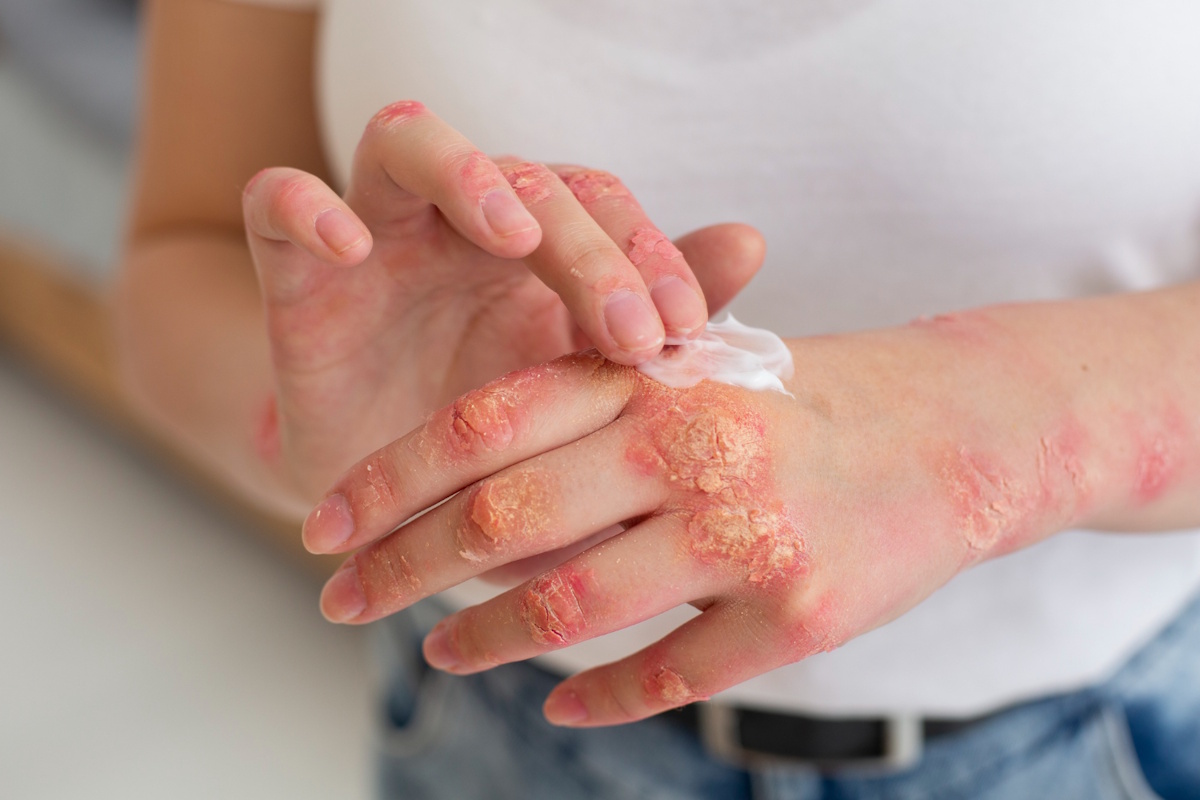
Topical treatment with emollient creams and corticosteroids is the first line of treatment in psoriasis covering a limited area. Photo: Freepik
For mild forms involving under 10% of the body surface, treatments applied to the skin are very effective and safe. Topical treatments (applied to the skin) include topical corticosteroids, vitamin D analogues, topical retinoids, topical immunomodulators and tars.
- Topical corticosteroids – the first line for limited areas; applied once or twice a day, in short courses, to avoid skin atrophy
- vitamin D analogues (calcipotriol, calcitriol) – frequently combined with corticosteroids
- Topical retinoids (tazarotene)
- topical calcineurin inhibitors (tacrolimus, pimecrolimus) – useful in psoriasis of the face and the folds
- Keratolytics (salicylic acid, urea, lactic acid, glycolic acid) – they reduce the scales and help the other treatments penetrate
- Tars – used particularly for psoriasis of the scalp
- Emollients – applied daily, they reduce scaling and itching
Salt baths (for example Dead Sea water or therapeutic salts) combined with careful sun exposure can bring additional benefits.
Phototherapy (treatment with ultraviolet light) for psoriasis
Light therapy is also called phototherapy. There are several kinds of UV light therapy, including PUVA (an acronym for psoralen + UVA), broadband UVB and narrowband UVB. These artificial light sources have been in use for decades and are generally available in certain hospitals and private clinics.
PUVA is a special treatment using a photosensitising medicine and a brief exposure to artificial light in the UVA spectrum. The photosensitising medicine in PUVA is called psoralen. These treatments are usually given in a clinic two to three times a week. Several weeks of PUVA therapy are needed before significant results are seen. The exposure time increases gradually with each treatment. Patients using PUVA are generally sensitive to the sun and have to avoid sun exposure for a period after PUVA has been given.
Narrowband UV phototherapy is a light treatment using a wavelength of 311 nm. It is given daily, or two to three times a week. UVB is also a component of natural sunlight. UVB dosing is based on time, and exposure increases gradually as it is tolerated.
Recently a laser has been developed (the XTRAC excimer laser) that generates ultraviolet light in the same range as narrowband ultraviolet light. This light can be beneficial for psoriasis confined to small areas of skin, such as the palms, the soles and the scalp. It is impractical in widespread forms.
What oral medicines are available for psoriasis?
The oral medicines include methotrexate, acitretin, ciclosporin, apremilast (Otezla) and others. Oral prednisone (a corticosteroid) is not generally used in psoriasis and can cause a flare of the disease if it is stopped.
- Acitretin (Neotigason) is an oral medicine used for certain kinds of psoriasis, on its own or combined with exposure to ultraviolet A. It is not effective in every kind of the disease. It can be used in men and in women who are not pregnant and do not intend to become pregnant for at least three years. The major side effects include dryness of the skin and the eyes and temporary rises in blood triglycerides and cholesterol.
- Ciclosporin is a powerful immunosuppressive medicine also used for other conditions, including organ transplantation. It can be used for severe cases of widespread psoriasis that are difficult to treat.
- Methotrexate is an antiproliferative medicine used for rheumatoid arthritis, and has been used effectively for many years in psoriasis. It is usually given in small weekly doses, either orally or by injection. Blood tests are needed before and during treatment.
The FDA has approved a new oral medicine, apremilast (Otezla), to treat psoriasis and psoriatic arthritis, with a completely new mode of action (inhibiting an enzyme, phosphodiesterase 4).
What injections or infusions are available for psoriasis?
Recently a new group of medicines called biologics has become available to treat psoriasis and psoriatic arthritis. All biological therapies work by suppressing certain specific parts of the inflammatory immune response. A convenient way of classifying these medicines is by their mode of action:
- Tumour necrosis factor-alpha antagonists (anti TNF-alpha) (certolizumab pegol [Cimzia], etanercept [Enbrel], adalimumab [Humira], infliximab [Remicade], golimumab [Simponi])
- Interleukin 12 and 23 inhibitors (anti IL-12/23) (ustekinumab [Stelara])
- Interleukin 17 inhibitors (anti IL-17) (secukinumab [Cosentyx], brodalumab [Siliq], ixekizumab [Taltz])
- Interleukin 23 inhibitor (anti IL-23) (guselkumab [Tremfya])
- T-cell inhibitor (abatacept (Orencia))
- Choosing the medicine can be difficult, and your doctor will help you choose the best option. Not all biological therapies are available in this country.
New medicines are in development and will doubtless be available in the near future. Since this class of medicine is quite new, patients continue to be monitored and adverse effects reported, and long-term safety continues to be watched. Recently the FDA has tried to address the problem of the prohibitive price of these medicines by allowing the use of “biosimilar” medicines. These are structurally identical to a specific biological medicine and are assumed to produce identical therapeutic responses in people, but are produced using a different methodology. Biosimilars should be available at a fraction of the cost of the original product. Whether this will prove an effective approach remains to be seen. The only biosimilar currently available is for infliximab (Inflectra). Two other biosimilar medicines have been accepted by the FDA: an equivalent of etanercept (Erelzi) and an equivalent of adalimumab (Amjevita) – but at present neither is available.
Is there a diet for psoriasis?
Most patients with psoriasis appear to be overweight. Since those patients are predisposed to developing cardiovascular disease and diabetes, it is strongly suggested that they try to maintain a normal body weight. Although the evidence is weak, it has been suggested that slimmer patients are more likely to respond to treatment.
Although dietary studies are difficult to interpret, it appears that an anti-inflammatory diet whose fat content is made up of polyunsaturated oils such as olive oil and fish oil is beneficial in psoriasis. The so-called Mediterranean diet is an example. The Mediterranean diet is rich in vegetables, fruit, oily fish, olive oil, nuts and whole grains, and is the best documented.
Recommended foods (with an anti-inflammatory effect)
- Oily fish (salmon, sardines, mackerel, herring) – a source of Omega 3
- Extra virgin olive oil, avocado, nuts, linseed and chia seeds
- Green leafy vegetables (spinach, kale, lettuce)
- Berries, citrus fruit, apples
- Antioxidant herbs: ginger, turmeric, sage, thyme
- Whole grains
Foods to limit or avoid
- Red meat and processed meats (rich in arachidonic acid and saturated fats)
- Full-fat dairy (cream, whole milk, rich cheeses)
- Ultra-processed foods, fast food, fried food
- Refined sugars and pastries
- Alcohol (especially beer) – it worsens inflammation and interferes with medication
- Nightshade vegetables (potatoes, tomatoes, aubergines, peppers) – in sensitive patients
Maintaining a normal body weight is essential: overweight patients respond less well to treatment and are at greater risk of cardiovascular comorbidities.
Can psoriasis be prevented?
Because psoriasis has a strong genetic component, preventing it from appearing altogether is not possible. For people already diagnosed, though, there are concrete measures that can reduce the frequency and the severity of flares and prolong periods of remission.
Strategies for preventing flares
- Moisturising the skin daily – applying fragrance-free emollients 2 to 3 times a day, especially after a shower, while the skin is still damp
- Gentle hygiene – a short shower with lukewarm (not hot) water, non-irritant, pH-neutral soaps; avoiding abrasive sponges
- Managing stress – relaxation techniques, meditation, yoga, psychotherapy, good sleep (7 to 8 hours a night)
- Regular physical activity – at least 150 minutes a week; it reduces systemic inflammation and helps with weight control
- Giving up smoking – smokers have more severe forms and respond less well to treatment
- Limiting alcohol
- Sensible sun protection – moderate sun exposure can ease the symptoms, but sunburn sets off flares (the Koebner phenomenon); using SPF 30+ every day is obligatory
- Avoiding injury to the skin – cuts, scratches, excessive rubbing, tattoos in exposed areas
- Treating infections promptly – particularly streptococcal sore throats
- Keeping vaccinations up to date – to reduce the risk of triggering infections
- A symptom diary – to identify your personal triggers (foods, situations, seasons)
- Periodic dermatological monitoring – even during periods of remission
Frequently asked questions about psoriasis
Is psoriasis contagious?
No. Psoriasis is a chronic immune-mediated disease, not an infection. It does not pass on through touch, kissing, sharing towels or using the same swimming pool. People with psoriasis can have a normal social and intimate life.
Can psoriasis be cured for good?
No, psoriasis is not at present curable. It can, however, go into remission for varying periods. Ongoing research is actively making progress towards better treatments and a possible cure in the future.
Is psoriasis hereditary?
There is a strong genetic predisposition, but inheritance is not inevitable. If one parent has psoriasis, the child's risk is about 15 to 20%. If both parents are affected, the risk is over 50%. Even so, many patients have no family history.
How long does a psoriasis flare last?
The duration varies a great deal, from a few weeks to months. With the right treatment begun in good time, most lesions improve within 4 to 12 weeks. Guttate psoriasis in children can disappear spontaneously within 2 to 3 months.
Can you go to the seaside or the swimming pool if you have psoriasis?
Yes. Moderate sun exposure frequently eases the symptoms, and sea water does good. Beware of sunburn, though (which can set off flares through the Koebner phenomenon), and of the chlorine in swimming pools, which can dry the skin. After swimming, a shower and emollients are recommended.
Does psoriasis affect life expectancy?
Psoriasis itself does not directly shorten life, but the associated comorbidities (cardiovascular disease, diabetes, metabolic syndrome) can have an impact. That is precisely why cardiac, lipid and metabolic monitoring is part of modern care.
Can women with psoriasis have children?
Yes. Pregnancy is not contraindicated, but the treatment has to be adjusted – methotrexate and acitretin are contraindicated in pregnancy and for a period before conception. Many patients notice their psoriasis improving during pregnancy, followed by a flare after the birth.
How does stress affect psoriasis?
Stress is one of the most powerful triggers of flares. Cortisol and other stress hormones activate the inflammatory cascade. Stress management techniques (meditation, cognitive therapy, exercise) are an integral part of treatment.
Are there blood tests for diagnosing psoriasis?
There is no specific blood test for the diagnosis, which is clinical. Blood tests are useful for assessing comorbidities, for monitoring systemic treatments and for the differential diagnosis with other conditions.
What is the long-term outlook in psoriasis?
Overall, the outlook for most patients with psoriasis is good. Even though it is not curable, it is controllable. As described above, recent studies show an association between psoriasis and other medical conditions, including obesity, diabetes and heart disease.
Book a dermatological consultation
If you notice red plaques with silvery scales, changes in the nails or joint pain that does not settle, book a dermatological consultation at Dermestetica.
Bibliography
- National Psoriasis Foundation – about Psoriasis
- American academy of Dermatology – Psoriasis: Overview, Causes, treatment
- Mayo Clinic – Psoriasis: symptoms and Causes
- World Health Organization – Global Report on Psoriasis
- DermNet NZ – Psoriasis