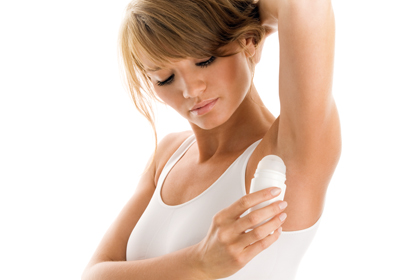
What are the differences between deodorants and antiperspirants? The view of the dermatology specialists at Dermestetica.
1. Which ingredients are harmful to the skin of the underarm?
Buying a deodorant looks straightforward, but we should pay attention to the substances that go into them, which on repeated contact with the skin could enter the body with potentially toxic effects.
In principle all the information about a deodorant's ingredients is printed on its packaging, which is why reading the information on each product carefully matters: it helps us avoid the unpleasant reactions that come of using an unsuitable deodorant.
The most important constituents of deodorants that are best avoided are the following:
– Parabens (methyl-, ethyl-, propyl-, benzyl- and propylparaben): these are toxic if they enter the bloodstream, and so applying them repeatedly to the skin through unsuitable deodorants may in time give rise to toxic effects. In addition, several clinical studies carried out in the past suggest a potential carcinogenic effect from prolonged exposure to parabens. The harmful effects of parabens may also extend to the reproductive system, since they can act like oestrogens and lead to changes in the reproductive organs.
– Chemical compounds containing aluminium (for example aluminium chlorohydrate, potassium aluminium sulfate): according to scientific research, once aluminium has entered the blood it accumulates in the tissues and cannot be eliminated from the body. In recent years a link has been established between the level of aluminium in the body and Alzheimer's disease. Clinical studies have not proved a clear link between the use of personal care products and this disease, but the long-term use of deodorants containing aluminium should be viewed with caution and research along these lines should continue.
– Triclosan: a substance classified as a pesticide, which was initially used in the deodorant industry too, for its action in destroying the bacteria on the skin and so reducing the smell of perspiration. As with aluminium, once triclosan has entered the body it can no longer be eliminated and accumulates in fatty tissue.
– Talc: recent scientific research has raised the alarm, having demonstrated the carcinogenic effect of talc after prolonged contact with the body. Talc-based deodorants are therefore best avoided
– Propylene glycol: another occasional ingredient of deodorants, for which a possible carcinogenic effect could not be ruled out with certainty. Among the adverse effects of chronic exposure to propylene glycol, neurotoxic effects, kidney and liver disorders and allergic reactions have been demonstrated.
– Silicon: deodorants containing this substance should be avoided, since it irritates the skin and may also have a carcinogenic effect.
It is advisable to use deodorants containing vegetable glycerine, and preservatives such as bioflavonoids, plant extracts, deionised or distilled water, green tea and aloe vera.
2. Is it a good idea to use deodorant at night as well?
There is no reason not to apply deodorant at night; with antiperspirants, on the other hand, it has been found that applying them before going to bed rather than in the morning increases how well they work, because the active substances have enough time to act throughout the night.
3. Is there a category of deodorant that should be avoided?
In principle all deodorants containing irritant or carcinogenic substances should be avoided, and deodorants based on natural ingredients are to be preferred.
4. What are the major differences between a deodorant and an antiperspirant?
A great many people believe that deodorants and antiperspirants are one and the same thing, but that is not so.
Antiperspirants contain very strong astringent substances such as aluminium salts (aluminium chloride at concentrations between 10 and 30%), which work by obstructing and blocking the excretory pores of the sweat glands, stopping the perspiration these glands produce from reaching the surface of the skin. Antiperspirants are indicated above all for people who suffer from hyperhidrosis, whether of the underarms or of the palms and soles.
Deodorants, by contrast, work by neutralising the smell of perspiration and through an antiseptic effect that destroys the bacteria causing the smell. Unlike antiperspirants, deodorants do not interfere with the body's temperature regulation or with the process of perspiring.
5. Is the difference between a spray, a roll-on and a stick one of form alone, or of substance too? Is one of them more effective?
In principle the same deodorant or antiperspirant, whether spray, roll-on or stick, works about as well at removing the unpleasant smell of perspiration. The difference shows at the moment of application: stick or solid deodorants have the advantage of drying quickly on the skin after application, but they leave unwelcome white marks as soon as they are applied, and the deodorant is not distributed evenly over the surface of the skin. With roll-on, liquid and spray deodorants the gel is distributed evenly on the skin and leaves no white marks as stick deodorants do, but they need a certain amount of time to dry on the surface of the skin after application.
6. Are the deodorants that promise to block perspiration for 48 hours unhealthy?
Since these antiperspirants contain aluminium chloride at varying concentrations, a few unpleasant reactions are to be expected after application to the skin, although they are relatively uncommon: a slight sensation of warmth immediately after application and localised itching, though in rare cases these adverse reactions can last longer. At the same time, using antiperspirants can also affect the clothes worn while they are applied.
In general, if there is no particular need for an antiperspirant, if we are not dealing with hyperhidrosis, it would be preferable to use a deodorant, since preventing perspiration by blocking the excretion of the sweat glands may not be the healthiest method for everyday care.