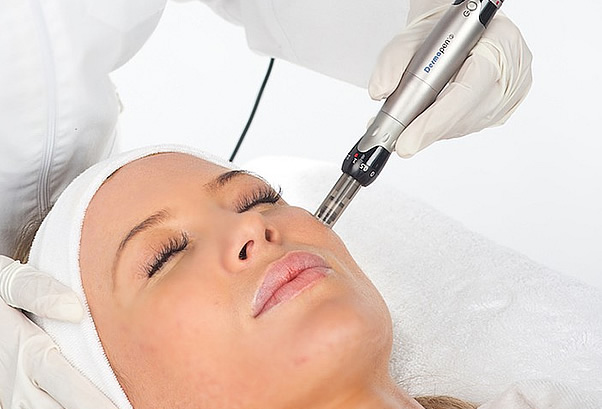
Microneedling, also known as collagen induction therapy, is a non-surgical treatment that consists of penetrating the skin with fine needles to improve its appearance.
What is DermaPen microneedling?
Microneedling (also known as collagen induction therapy) is a non-surgical treatment that consists of penetrating the skin with fine needles in order to improve its appearance. It may sound a little medieval, but most skin rejuvenation treatments, whether with lasers or chemicals, manipulate a healing response from the body in order to create a structural and cosmetic benefit.
The procedure is indicated for fading post-acne and post-surgical scars and stretch marks, for smoothing fine lines and wrinkles, for evening out colour, for refining enlarged pores, and for increasing the tone and elasticity of the skin.
What are the advantages and disadvantages of microneedling?
For
- The treatment is quick (60 minutes in total) and comfortable (an anaesthetic cream is used).
- Microneedling offers benefits in the short term as well as the long term. There is an immediate result that patients describe as a “glow” to the skin, which is in fact mainly to do with the temporary swelling, but which serves as a pleasant interim benefit until the long-term result — the production of collagen — takes effect.
- The treatment can be tailored to work intensively on localised problem areas, such as scars, the area around the eyes, or the lines of the neck or the décolletage.
- Recovery time is usually 2 to 4 days and is directly proportional to the intensity of the treatment received and to the result obtained.
- Microneedling involves no delivery of heat, so it has a safety profile suited to every skin tone, with no risk of the pigmentation problems that can accompany other procedures
- Although it is mostly used on the face, neck, décolletage and hands, microneedling can be done anywhere on the body.
- It can be used on its own or combined with other treatments that increase how well it works (PRP, skin biorevitalisation).
Against
- If the doctor's instructions are not followed, complications may arise, including infection and hyperpigmentation.
- You will need a series of treatments to obtain the full benefit, and maintenance sessions are needed to keep it.
- While the treatment is effective for lax skin, particularly around the eyes and along the jawline, it does not produce a significant facial lift.
- The skin will be sensitive to the sun after the treatment and direct UV exposure should be avoided.
- It is not recommended for patients with active skin conditions, such as eczema, herpes or active acne.
Who is a good candidate for microneedling?
- Patients in good general health (with no infection, fever or skin eruption) are good candidates for microneedling.
- There are relatively few risks with this treatment, but it is not recommended for women who are pregnant or breastfeeding.
- Microneedling causes micro-injury to the skin, which can reactivate herpes simplex infection. Tell your doctor if you know you have this infection, so that the correct prophylaxis can be given.
What are the benefits of the DermaPen?
By creating microscopic punctures in the skin, the device creates thousands of tiny injuries. This sets off a healing response that releases a cascade of growth factors, which in turn stimulates the production of the body's own collagen (the protein fibres that keep the skin smooth and supple).
It is a form of fractional treatment, which means that only a fraction of the surface of the skin is affected, so recovery time is relatively short.
Microneedling also allows substances applied to the skin before the treatment to penetrate dramatically better and work more effectively, by creating channels for the absorption of topical products.
How effective is this treatment?
Microneedling is effective for scars, although the degree of improvement depends on the kind of scar. In a 2015 study of post-acne scars, DermaPen treatments produced a good to very good response in depressed, wide, shallow scars, while narrow, deep (icepick) scars had a moderate to poor response.
Studies also show that stretch marks can be improved by DermaPen treatment; it takes consistent, long-term treatment, though — often six or seven sessions — to make them less visible.
In a 2018 study of patients between 35 and 75 years old, researchers reported a visible improvement in lines and wrinkles, in laxity and in the texture of the skin three months after the first of four monthly DermaPen treatments — and the improvements carried on for another two months. The increase in skin tone, the researchers noted, was largely due to the conversion of collagen III, the type found in mature skin, into collagen I, the type found in younger skin — a process that can take up to a year to complete. Even so, the results are not permanent; they have to be maintained with touch-up treatments.
What happens during a DermaPen treatment?
Microneedling without anaesthesia is painful, so about 30 minutes before the procedure a topical anaesthetic cream is applied to the target area. Then, depending on the condition being treated, an active serum is applied.
The DermaPen is an automated device holding sterile single-use cartridges with a number of needles. DermaPen devices are used with a rapid gliding or stamping motion over the skin. The length of the needles varies with the skin type and with the condition being treated.
What should you expect after microneedling?
After DermaPen microneedling the skin will be erythematous (reddish) for about 24 to 48 hours, depending on the intensity of the treatment. Naturally this also depends on the patient's skin type. Fair skin types may show prolonged redness.
We usually advise patients to schedule the treatment at least a week before an event. That allows adequate time for recovery.
You can wash your face within 8 hours (or sooner if your doctor advises it). With make-up, you can usually go to work the next day.
What can you use for aftercare?
In general, a product with growth factors and peptides is recommended, to supply the building blocks the skin needs to repair itself. Growth factors help shorten healing time, optimise the result of the treatment and improve tone, texture and elasticity.
It is important to keep the skin moisturised during recovery. Use only the products your doctor recommends. Occlusive products can cover the pores and cause milia.
How soon will you see the results of microneedling?
You should notice a difference in the texture of the skin a week after the first treatment — most patients first notice a reduction in the size of the pores, and an improvement in the appearance of post-acne scars or wrinkles after at least three treatments.
The skin is firmer, brighter and healthier. And although there is no magic treatment for post-acne scars, the DermaPen can be more effective than laser treatments that cost a great deal more.
How long do the results of microneedling last?
It depends on your age and on the condition of your skin.
After a full series of 4 to 6 treatments, maintenance treatments may be needed, on a schedule set by the doctor, to keep the result.
Can I have a hyaluronic acid filler treatment at the same time as microneedling?
To be safe, it is best to wait between procedures, either to let the skin heal after the DermaPen or to let the hyaluronic acid integrate into the tissue. Our recommendation is to wait 2 weeks between treatments.