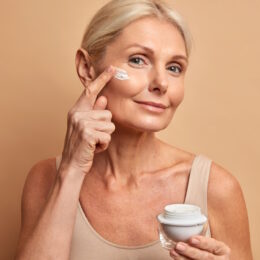

Oestrogen creams can improve the firmness, hydration and elasticity of the skin, but they also carry possible risks. Find out what the studies say.
Anti-ageing creams with oestrogen have become a more and more discussed subject in recent years, particularly among women who notice visible changes in their skin as they grow older. The loss of firmness, the appearance of wrinkles and the drop in hydration are closely bound up with the fall in the level of oestrogen in the body, and the idea of applying this hormone directly to the skin seems, at first sight, a simple and effective solution.
Doctors have observed over time that women following hormone therapies have skin that is more elastic, better hydrated and more luminous. Starting from these observations, a natural question arose: if oestrogen helps the skin from within, could it have the same effect applied directly to the skin?
To answer this question, several studies have been carried out examining the effects of oestrogen creams and also their safety. More recent research shows that the skin contains mainly beta-type oestrogen receptors, which appear to play an important part in regeneration, in inflammatory balance and in maintaining the structure of the skin. In other words, the skin is biologically ready to respond to oestrogen, which explains why these creams have attracted so much interest in dermatology.
In this article we explain what this research says, what the real benefits are, and which risks to watch out for if you are considering such a treatment.
In brief: what you should know about oestrogen creams
- they can improve the elasticity, hydration and firmness of the skin
- the most studied formulas contain 0.3% estriol or 0.01% estradiol
- the results appear better on skin less affected by the sun
- studies have shown benefits for collagen, for the epidermis and for the texture of the skin
- there are, however, questions about systemic absorption (into the body as a whole) and about long-term safety
What anti-ageing oestrogen creams are and how they are used
Anti-ageing oestrogen creams are products applied directly to the skin, containing hormones such as estriol or estradiol, which help improve the appearance of the skin. In practice they support the skin in regaining its firmness, its elasticity and its level of hydration, particularly at times when the body produces less oestrogen, such as the menopause.
These creams usually contain:
- estriol (the commonest, at concentrations of up to 0.3%)
- estradiol (more potent, but at lower concentrations, around 0.01%)
Besides these, some products may also contain plant oestrogens (phytoestrogens) or synthetic versions.
They are applied directly to the skin, most often on:
- the face
- the neck
- other areas where the skin has lost firmness
An important thing to know is that the results can differ according to the area treated. Studies have shown that skin not affected by the sun (covered areas) responds far better, becoming smoother and more elastic. Skin exposed for a long time to the sun or to sunbeds, on the other hand, may respond more weakly, because it is already affected by inflammation and by the breakdown of collagen.
In short, these creams can have visible effects on the skin, but they work best when the skin is cared for properly and protected from the sun.
Who can use oestrogen creams and when they are recommended
Oestrogen creams are used particularly by women in the peri- or postmenopause, when the natural level of oestrogen falls and visible changes appear in the skin: dryness, loss of firmness and more pronounced wrinkles. These products may be considered particularly when:
- the skin becomes thinner and drier
- elasticity is lost
- wrinkles become more visible
- other anti-ageing treatments no longer give satisfactory results
Even so, they should be used with caution and only on a doctor's recommendation, because, as the studies show, oestrogens applied locally can also have effects on the body as a whole
What the studies say about anti-ageing creams with oestrogen
Clinical studies on small groups of patients have shown that oestrogens have beneficial effects on the structure of the skin, with multiple roles such as increasing elasticity through the formation of collagen and elastin, improving the level of hydration and the blood supply, and increasing tone and the capacity to regenerate, so that they quickly became key ingredients in anti-ageing therapy. Topical preparations with oestrogens (estriol at concentrations of up to 0.3%, or estradiol at concentrations of 0.01%) have been used off label more and more in recent years, despite the fact that the scientific data on the safety of using them long term are limited.
The enthusiasm for using oestrogen creams came from the clinical observation that the quality and structure of the skin improved dramatically in peri- and postmenopausal patients receiving hormone replacement therapy. These observations, along with in vitro and animal studies, supported the theory that oestrogens could be a powerful anti-ageing ingredient. Multiple lines of research are under way into the systemic effects of these topical preparations applied to the skin over the long term. Numerous medical bodies warn patients about an increased risk of cancers of the genital tract and advise them to have periodic screening investigations.
Absorption into the body and systemic impact (on the body as a whole)
It was found that episodes of flushing (vasomotor waves) became rarer and rarer, to the point of disappearing, in patients using such preparations, which clearly demonstrates systemic absorption. Even so, the popularity of products containing topical oestrogens is rising, and market analyses estimate that sales will reach 2.1 billion dollars by 2033.
Kinds of oestrogen used in creams
Topical products may contain natural bioidentical oestrogens, simple or conjugated, synthetic ones (methyl estradiol propanoate) or plant-derived ones (phytoestrogens).
Estradiol (E2) and estriol (E3) are the most studied compounds in research on anti-ageing therapies. E2 is the predominant hormone before the menopause and is more potent, while E3 is a weaker metabolite and is considered to have a better safety profile because of its smaller systemic effect and its shorter half-life. Most topical formulas contain 0.3% estriol.
How oestrogens act on the skin
Applied to the skin, they bind to the alpha receptors (αER) present in fibroblasts and keratinocytes and to the beta receptors (βER), which are very abundant in the skin and have a part in anti-inflammatory functions, as well as to the rapid G receptors on the cell membrane, which influence hydration and microcirculation.
In the dermis, the fibroblasts are stimulated and their density increases; they produce new type I and III collagen and elastin. They also inhibit MMP-1 (metalloproteinase 1), the main enzymes that break collagen down. Patients with pronounced actinic damage (skin affected by prolonged exposure to the sun or to sunbeds) did not see the same benefits from applying oestrogen creams, because of the chronic inflammation, the considerable oxidative stress in the skin and, with it, the breakdown of collagen.
The influence of sun exposure on the results
Comparative studies were carried out applying the same product, on the same patient, to sun-exposed areas (the face) and photoprotected ones (the body), and the results were entirely different, in the sense that the texture of the skin improved greatly in the photoprotected areas, unlike the face, where the changes were minimal.
So for good results with any anti-ageing therapy, sun protection in every season is obligatory.
The effects of oestrogen creams on the skin
The effects on the blood supply of the skin are still being assessed. A double-blind study over 24 weeks by Moraes et al. found a 77% increase in the density of vessels in the dermis, while Fuchs et al. found no significant histological changes over a similar period.
In conclusion, topical oestrogens may influence the dermal blood supply, but more substantial studies over longer periods are needed.
In the epidermis, most studies have found important and beneficial changes, in the sense of a thickening of the epidermis due to the stimulation of keratinocyte proliferation. The integrity of the epidermal barrier and the retention of water in the cells were also found to be restored.
The results obtained from treatment
Comparative studies against placebo showed that about 88% of patients treated with topical E2 and E3 oestrogens reported an improved appearance of the face, through greater elasticity and firmness, softened wrinkles and smaller pores, after a period of 6 months.
Patients with actinically damaged skin did not have the same kind of results, and the results with phytoestrogen preparations were inconsistent.
It is important to understand, though, that the improvements observed under the microscope, such as an increase in collagen or a thickening of the epidermis, do not automatically mean striking results visible to the naked eye. Some studies have shown promising biological changes, but the clinical results were less consistent, especially on heavily photoaged skin.
Adverse reactions and risks of oestrogen creams
The preparations are generally well tolerated, with adverse effects limited to slight redness, itching or hypersensitivity, which resolve when the application stops.
Even so, a few studies have reported systemic effects such as rises in prolactin, breast tenderness, telangiectasias and melasma. So we have to be aware that oestrogens pass beyond the skin. In that case a visit to an endocrinologist or gynaecologist is needed, who will order a set of blood tests and imaging investigations at regular intervals, so that the menopause can be passed through safely.
Oestrogen creams versus other anti-ageing treatments
An important thing to consider is how oestrogen creams compare with other established anti-ageing treatments. For example, tretinoin (a vitamin A derivative) remains the current reference standard in anti-ageing treatments, with results proven both clinically and histologically. By comparison, topical oestrogens have promising results, but have not yet reached the same level of scientific evidence.
That does not mean they do not work, but that they are still being assessed, particularly as regards long-term safety.
In conclusion, there are promising results with oestrogen preparations, but more studies are needed to judge the safety of using them long term as regards the risk of cancers of the genital tract or other biological effects on the body as a whole.
FAQ: frequently asked questions about oestrogen creams
Are oestrogen creams safe?
In general they are well tolerated locally, but there is evidence that they can be absorbed into the body. They should therefore be used with caution and, ideally, on a doctor's recommendation, especially over the long term.
Can oestrogen creams have hormonal effects in the body?
Yes; some studies have shown that systemic effects can appear, which means that oestrogen applied to the skin can reach the general circulation. Hormonal changes, or symptoms such as breast tenderness, have been observed, for example.
Can I use oestrogen creams if my skin is sensitive?
In general they are well tolerated, but mild reactions such as redness or itching can appear. If your skin is sensitive, it is advisable to test the product on a small area or to talk to a dermatologist.
Do oestrogen creams work on sun-damaged skin?
The results may be weaker on photoaged skin. Studies show that skin affected by chronic sun exposure responds less well to this kind of treatment.
Can oestrogen creams replace other anti-ageing treatments?
Not entirely. Although they have beneficial effects, they have not reached the level of effectiveness of established treatments such as tretinoin. They are often used alongside others rather than as the only solution.
Is a prescription needed for oestrogen creams?
In many cases, yes. These products are considered hormonal preparations and are not equivalent to ordinary cosmetic creams.
Who should avoid oestrogen creams?
People with hormonal conditions, a history of hormone-dependent cancer or other endocrine problems should avoid using them without medical advice. A specialist consultation is essential before use.
Bibliography
- https://onlinelibrary.wiley.com/doi/10.1034/j.1600-0625.2002.110601.x
- https://www.sciencedirect.com/science/article/pii/S2950198925001035?ref=pdf_download&fr=RR-2&rr=9e79530f09b523c9
- https://onlinelibrary.wiley.com/doi/10.1111/j.1600-0625.2004.00259.x
- https://www.sciencedirect.com/science/article/abs/pii/0378512287900454